This new device uses light to perform the key operations of a deep neural network on a chip, opening the door to high-speed processors that can learn in real-time.
Adam Zewe | MIT News
Publication Date:
December 2, 2024
The deep neural network models that power today’s most demanding machine-learning applications have grown so large and complex that they are pushing the limits of traditional electronic computing hardware.
Photonic hardware, which can perform machine-learning computations with light, offers a faster and more energy-efficient alternative. However, there are some types of neural network computations that a photonic device can’t perform, requiring the use of off-chip electronics or other techniques that hamper speed and efficiency.
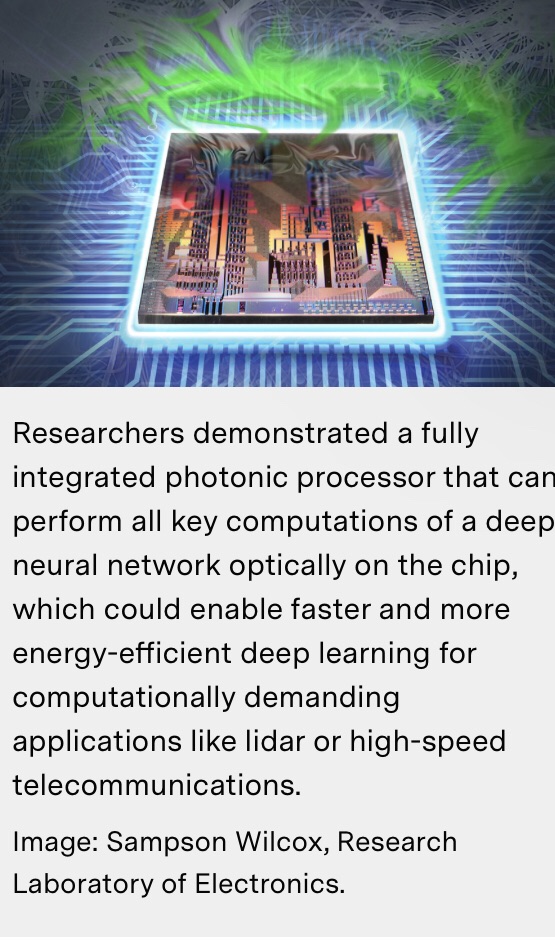
Building on a decade of research, scientists from MIT and elsewhere have developed a new photonic chip that overcomes these roadblocks. They demonstrated a fully integrated photonic processor that can perform all the key computations of a deep neural network optically on the chip.
The optical device was able to complete the key computations for a machine-learning classification task in less than half a nanosecond while achieving more than 92 percent accuracy — performance that is on par with traditional hardware.
The chip, composed of interconnected modules that form an optical neural network, is fabricated using commercial foundry processes, which could enable the scaling of the technology and its integration into electronics.
In the long run, the photonic processor could lead to faster and more energy-efficient deep learning for computationally demanding applications like lidar, scientific research in astronomy and particle physics, or high-speed telecommunications.
“There are a lot of cases where how well the model performs isn’t the only thing that matters, but also how fast you can get an answer. Now that we have an end-to-end system that can run a neural network in optics, at a nanosecond time scale, we can start thinking at a higher level about applications and algorithms,” says Saumil Bandyopadhyay ’17, MEng ’18, PhD ’23, a visiting scientist in the Quantum Photonics and AI Group within the Research Laboratory of Electronics (RLE) and a postdoc at NTT Research, Inc., who is the lead author of a paper on the new chip.
Bandyopadhyay is joined on the paper by Alexander Sludds ’18, MEng ’19, PhD ’23; Nicholas Harris PhD ’17; Darius Bunandar PhD ’19; Stefan Krastanov, a former RLE research scientist who is now an assistant professor at the University of Massachusetts at Amherst; Ryan Hamerly, a visiting scientist at RLE and senior scientist at NTT Research; Matthew Streshinsky, a former silicon photonics lead at Nokia who is now co-founder and CEO of Enosemi; Michael Hochberg, president of Periplous, LLC; and Dirk Englund, a professor in the Department of Electrical Engineering and Computer Science, principal investigator of the Quantum Photonics and Artificial Intelligence Group and of RLE, and senior author of the paper. The research appears today in Nature Photonics.
Machine learning with light
Deep neural networks are composed of many interconnected layers of nodes, or neurons, that operate on input data to produce an output. One key operation in a deep neural network involves the use of linear algebra to perform matrix multiplication, which transforms data as it is passed from layer to layer.
But in addition to these linear operations, deep neural networks perform nonlinear operations that help the model learn more intricate patterns. Nonlinear operations, like activation functions, give deep neural networks the power to solve complex problems.
In 2017, Englund’s group, along with researchers in the lab of Marin Soljačić, the Cecil and Ida Green Professor of Physics, demonstrated an optical neural network on a single photonic chip that could perform matrix multiplication with light.
But at the time, the device couldn’t perform nonlinear operations on the chip. Optical data had to be converted into electrical signals and sent to a digital processor to perform nonlinear operations.
“Nonlinearity in optics is quite challenging because photons don’t interact with each other very easily. That makes it very power consuming to trigger optical nonlinearities, so it becomes challenging to build a system that can do it in a scalable way,” Bandyopadhyay explains.
They overcame that challenge by designing devices called nonlinear optical function units (NOFUs), which combine electronics and optics to implement nonlinear operations on the chip.
The researchers built an optical deep neural network on a photonic chip using three layers of devices that perform linear and nonlinear operations.
A fully-integrated network
At the outset, their system encodes the parameters of a deep neural network into light. Then, an array of programmable beamsplitters, which was demonstrated in the 2017 paper, performs matrix multiplication on those inputs.
The data then pass to programmable NOFUs, which implement nonlinear functions by siphoning off a small amount of light to photodiodes that convert optical signals to electric current. This process, which eliminates the need for an external amplifier, consumes very little energy.
“We stay in the optical domain the whole time, until the end when we want to read out the answer. This enables us to achieve ultra-low latency,” Bandyopadhyay says.
Achieving such low latency enabled them to efficiently train a deep neural network on the chip, a process known as in situtraining that typically consumes a huge amount of energy in digital hardware.
“This is especially useful for systems where you are doing in-domain processing of optical signals, like navigation or telecommunications, but also in systems that you want to learn in real time,” he says.
The photonic system achieved more than 96 percent accuracy during training tests and more than 92 percent accuracy during inference, which is comparable to traditional hardware. In addition, the chip performs key computations in less than half a nanosecond.
“This work demonstrates that computing — at its essence, the mapping of inputs to outputs — can be compiled onto new architectures of linear and nonlinear physics that enable a fundamentally different scaling law of computation versus effort needed,” says Englund.
The entire circuit was fabricated using the same infrastructure and foundry processes that produce CMOS computer chips. This could enable the chip to be manufactured at scale, using tried-and-true techniques that introduce very little error into the fabrication process.
Scaling up their device and integrating it with real-world electronics like cameras or telecommunications systems will be a major focus of future work, Bandyopadhyay says. In addition, the researchers want to explore algorithms that can leverage the advantages of optics to train systems faster and with better energy efficiency.
This research was funded, in part, by the U.S. National Science Foundation, the U.S. Air Force Office of Scientific Research, and NTT Research.
Article link: https://news.mit.edu/2024/photonic-processor-could-enable-ultrafast-ai-computations-1202
 healthcarereimagined