healthcarereimagined

Envisioning healthcare for the 21st century

  • About
  • Economics

Light-Speed Breakthrough: The Dawn of Photonic In-Memory Computing

Posted by timmreardon on 10/28/2024
Posted in: Uncategorized.


BY UNIVERSITY OF PITTSBURGH OCTOBER 26, 2024
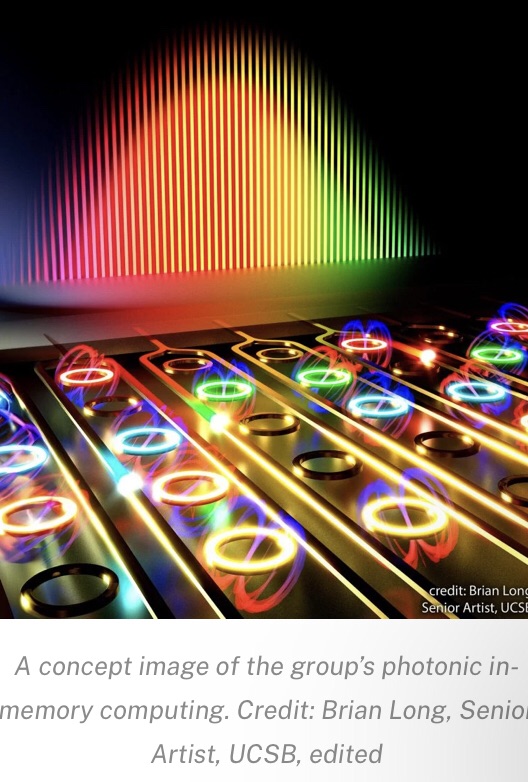
Researchers have unveiled a new photonic in-memory computing method that promises to advance optical computing significantly.

This technology, using magneto-optical materials, achieves high-speed, low-energy, and durable memory solutions suitable for integration with existing computing technologies.

Photonic In-Memory Computing

For the first time, a global team of electrical engineers has developed a new method for photonic in-memory computing, bringing optical computing closer to becoming a reality.

The team includes researchers from the University of Pittsburgh Swanson School of Engineering, the University of California – Santa Barbara, the University of Cagliari, and the Tokyo Institute of Technology (now the Institute of Science Tokyo). Their results were published on October 23 in the journal Nature Photonics(“Integrated non-reciprocal magneto-optics with ultra-high endurance for photonic in-memory computing.”

This research was a collaborative effort led by Nathan Youngblood, assistant professor of electrical and computer engineering at Pitt, along with Paulo Pintus, formerly of UC Santa Barbara and now an assistant professor at the University of Cagliari, and Yuya Shoji, associate professor at the Institute of Science Tokyo.

Overcoming Optical Memory Limitations

Until now, researchers have been limited in developing photonic memory for AI processing – gaining one important attribute like speed while sacrificing another like energy usage. In the article, the international team demonstrates a unique solution that addresses current limitations of optical memory that have yet to combine non-volatility, multibit storage, high switching speed, low switching energy, and high endurance in a single platform.

“The materials we use in developing these cells have been available for decades. However, they have primarily been used for static optical applications, such as on-chip isolators rather than a platform for high-performance photonic memory,” Youngblood explained. “This discovery is a key enabling technology toward a faster, more efficient, and more scalable optical computing architecture that can be directly programmed with CMOS (complementary metal-oxide semiconductor) circuitry – which means it can be integrated into today’s computer technology.

“Additionally, our technology showed three orders of magnitude better endurance than other non-volatile approaches, with 2.4 billion switching cycles and nanosecond speeds.”

Introducing a Resonance-Based Architecture

The authors propose a resonance-based photonic architecture that leverages the non-reciprocal phase shift in magneto-optical materials to implement photonic in-memory computing.

A typical approach to photonic processing is to multiply a rapidly changing optical input vector with a matrix of fixed optical weights. However, encoding these weights on-chip using traditional methods and materials has proven challenging. By using magneto-optic memory cells comprised of heterogeneously integrated cerium-substituted yttrium iron garnet (Ce:YIG) on silicon micro-ring resonators, the cells cause light to propagate bidirectionally, like sprinters running opposite directions on a track.

Computing by Controlling the Speed of Light

“It’s like the wind is blowing against one sprinter while helping the other run faster,” explained Pintus, who led the experimental work at UC Santa Barbara. “By applying a magnetic field to the memory cells, we can control the speed of light differently depending on whether the light is flowing clockwise or counterclockwise around the ring resonator. This provides an additional level of control not possible in more conventional non-magnetic materials.”

Future Prospects and Scaling

The team is now working to scale up from a single memory cell to a large-scale memory array which can support even more data for computing applications. They note in the article that the non-reciprocal magneto-optic memory cell offers an efficient non-volatile storage solution that could provide unlimited read/write endurance at sub-nanosecond programming speeds.

“We also believe that future advances of this technology could use different effects to improve the switching efficiency,” Shoji at Tokyo added, “and that new fabrication techniques with materials other than Ce:YIG and more precise deposition can further advance the potential of non-reciprocal optical computing.”

Reference: “Integrated non-reciprocal magneto-optics with ultra-high endurance for photonic in-memory computing” by Paolo Pintus, Mario Dumont, Vivswan Shah, Toshiya Murai, Yuya Shoji, Duanni Huang, Galan Moody, John E. Bowers and Nathan Youngblood, 23 October 2024, Nature Photonics.
DOI: 10.1038/s41566-024-01549-1

Other researchers on this project include:

  • John E. Bowers, distinguished faculty at University of California at Santa Barbara
  • Mario Dumont, graduate student researcher at University of California at Santa Barbara
  • Duanni Huang, former researcher at University of California at Santa Barbara
  • Galan Moody, faculty at University of California at Santa Barbara
  • Toshiya Murai, researcher at National Institute of Advanced Industrial Science and Technology, Japan
  • Vivswan Shah, graduate student researcher at University of Pittsburgh

Article link: https://scitechdaily.com/light-speed-breakthrough-the-dawn-of-photonic-in-memory-computing/

Share this:

  • Click to share on X (Opens in new window) X
  • Click to share on Facebook (Opens in new window) Facebook
  • Click to share on LinkedIn (Opens in new window) LinkedIn
Like Loading...

Related

Posts navigation

← Nobody knows how AI works – MIT Technology Review
The 15 Diseases of Leadership, According to Pope Francis – Some Wisdom for Voters on Leadership →
  • Search site

  • Follow healthcarereimagined on WordPress.com
  • Recent Posts

    • Decisions about AI will last decades. Researchers need better frameworks – Bulletin of the Atomic Scientists 12/29/2025
    • Quantum computing reality check: What business needs to know now – MIT Sloan 12/29/2025
    • AI’s missing ingredient: Shared wisdom – MIT Sloan 12/21/2025
    • Hype Correction – MIT Technology Review 12/15/2025
    • Semantic Collapse – NeurIPS 2025 12/12/2025
    • The arrhythmia of our current age – MIT Technology Review 12/11/2025
    • AI: The Metabolic Mirage 12/09/2025
    • When it all comes crashing down: The aftermath of the AI boom – Bulletin of the Atomic Scientists 12/05/2025
    • Why Digital Transformation—And AI—Demands Systems Thinking – Forbes 12/02/2025
    • How artificial intelligence impacts the US labor market – MIT Sloan 12/01/2025
  • Categories

    • Accountable Care Organizations
    • ACOs
    • AHRQ
    • American Board of Internal Medicine
    • Big Data
    • Blue Button
    • Board Certification
    • Cancer Treatment
    • Data Science
    • Digital Services Playbook
    • DoD
    • EHR Interoperability
    • EHR Usability
    • Emergency Medicine
    • FDA
    • FDASIA
    • GAO Reports
    • Genetic Data
    • Genetic Research
    • Genomic Data
    • Global Standards
    • Health Care Costs
    • Health Care Economics
    • Health IT adoption
    • Health Outcomes
    • Healthcare Delivery
    • Healthcare Informatics
    • Healthcare Outcomes
    • Healthcare Security
    • Helathcare Delivery
    • HHS
    • HIPAA
    • ICD-10
    • Innovation
    • Integrated Electronic Health Records
    • IT Acquisition
    • JASONS
    • Lab Report Access
    • Military Health System Reform
    • Mobile Health
    • Mobile Healthcare
    • National Health IT System
    • NSF
    • ONC Reports to Congress
    • Oncology
    • Open Data
    • Patient Centered Medical Home
    • Patient Portals
    • PCMH
    • Precision Medicine
    • Primary Care
    • Public Health
    • Quadruple Aim
    • Quality Measures
    • Rehab Medicine
    • TechFAR Handbook
    • Triple Aim
    • U.S. Air Force Medicine
    • U.S. Army
    • U.S. Army Medicine
    • U.S. Navy Medicine
    • U.S. Surgeon General
    • Uncategorized
    • Value-based Care
    • Veterans Affairs
    • Warrior Transistion Units
    • XPRIZE
  • Archives

    • December 2025 (11)
    • November 2025 (9)
    • October 2025 (10)
    • September 2025 (4)
    • August 2025 (7)
    • July 2025 (2)
    • June 2025 (9)
    • May 2025 (4)
    • April 2025 (11)
    • March 2025 (11)
    • February 2025 (10)
    • January 2025 (12)
    • December 2024 (12)
    • November 2024 (7)
    • October 2024 (5)
    • September 2024 (9)
    • August 2024 (10)
    • July 2024 (13)
    • June 2024 (18)
    • May 2024 (10)
    • April 2024 (19)
    • March 2024 (35)
    • February 2024 (23)
    • January 2024 (16)
    • December 2023 (22)
    • November 2023 (38)
    • October 2023 (24)
    • September 2023 (24)
    • August 2023 (34)
    • July 2023 (33)
    • June 2023 (30)
    • May 2023 (35)
    • April 2023 (30)
    • March 2023 (30)
    • February 2023 (15)
    • January 2023 (17)
    • December 2022 (10)
    • November 2022 (7)
    • October 2022 (22)
    • September 2022 (16)
    • August 2022 (33)
    • July 2022 (28)
    • June 2022 (42)
    • May 2022 (53)
    • April 2022 (35)
    • March 2022 (37)
    • February 2022 (21)
    • January 2022 (28)
    • December 2021 (23)
    • November 2021 (12)
    • October 2021 (10)
    • September 2021 (4)
    • August 2021 (4)
    • July 2021 (4)
    • May 2021 (3)
    • April 2021 (1)
    • March 2021 (2)
    • February 2021 (1)
    • January 2021 (4)
    • December 2020 (7)
    • November 2020 (2)
    • October 2020 (4)
    • September 2020 (7)
    • August 2020 (11)
    • July 2020 (3)
    • June 2020 (5)
    • April 2020 (3)
    • March 2020 (1)
    • February 2020 (1)
    • January 2020 (2)
    • December 2019 (2)
    • November 2019 (1)
    • September 2019 (4)
    • August 2019 (3)
    • July 2019 (5)
    • June 2019 (10)
    • May 2019 (8)
    • April 2019 (6)
    • March 2019 (7)
    • February 2019 (17)
    • January 2019 (14)
    • December 2018 (10)
    • November 2018 (20)
    • October 2018 (14)
    • September 2018 (27)
    • August 2018 (19)
    • July 2018 (16)
    • June 2018 (18)
    • May 2018 (28)
    • April 2018 (3)
    • March 2018 (11)
    • February 2018 (5)
    • January 2018 (10)
    • December 2017 (20)
    • November 2017 (30)
    • October 2017 (33)
    • September 2017 (11)
    • August 2017 (13)
    • July 2017 (9)
    • June 2017 (8)
    • May 2017 (9)
    • April 2017 (4)
    • March 2017 (12)
    • December 2016 (3)
    • September 2016 (4)
    • August 2016 (1)
    • July 2016 (7)
    • June 2016 (7)
    • April 2016 (4)
    • March 2016 (7)
    • February 2016 (1)
    • January 2016 (3)
    • November 2015 (3)
    • October 2015 (2)
    • September 2015 (9)
    • August 2015 (6)
    • June 2015 (5)
    • May 2015 (6)
    • April 2015 (3)
    • March 2015 (16)
    • February 2015 (10)
    • January 2015 (16)
    • December 2014 (9)
    • November 2014 (7)
    • October 2014 (21)
    • September 2014 (8)
    • August 2014 (9)
    • July 2014 (7)
    • June 2014 (5)
    • May 2014 (8)
    • April 2014 (19)
    • March 2014 (8)
    • February 2014 (9)
    • January 2014 (31)
    • December 2013 (23)
    • November 2013 (48)
    • October 2013 (25)
  • Tags

    Business Defense Department Department of Veterans Affairs EHealth EHR Electronic health record Food and Drug Administration Health Health informatics Health Information Exchange Health information technology Health system HIE Hospital IBM Mayo Clinic Medicare Medicine Military Health System Patient Patient portal Patient Protection and Affordable Care Act United States United States Department of Defense United States Department of Veterans Affairs
  • Upcoming Events

Blog at WordPress.com.
  • Reblog
  • Subscribe Subscribed
    • healthcarereimagined
    • Join 153 other subscribers
    • Already have a WordPress.com account? Log in now.
    • healthcarereimagined
    • Subscribe Subscribed
    • Sign up
    • Log in
    • Copy shortlink
    • Report this content
    • View post in Reader
    • Manage subscriptions
    • Collapse this bar
 

Loading Comments...
 

    %d