healthcarereimagined

Envisioning healthcare for the 21st century

  • About
  • Economics

China Unveils First Homegrown AI PC Processor – Techovedas

Posted by timmreardon on 08/03/2024
Posted in: Uncategorized.

EDITORIAL TEAM

AUGUST 1, 2024

INTERNATIONAL, SEMICONDUCTOR NEWS

    Introduction

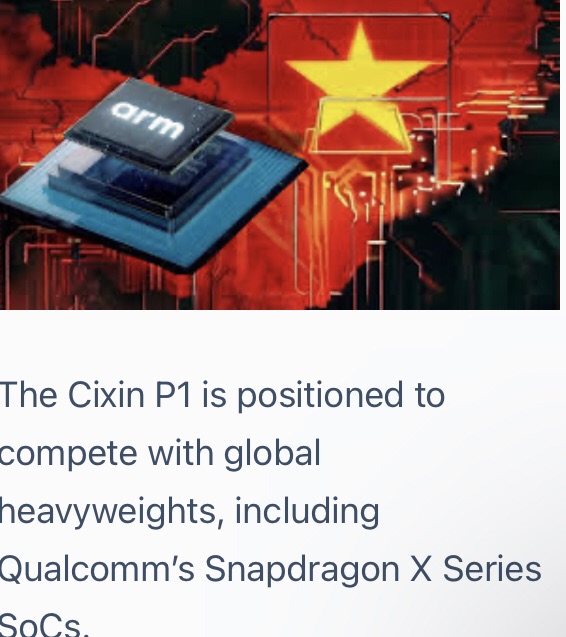
    In a notable advancement for China’s technology sector, Cixin Technology has launched the Cixin P1, the country’s first domestically developed “AI PC”  processor.

    This significant achievement underscores China’s growing capabilities in high-performance computing and artificial intelligence (AI). 

    Purpose-built for  AI tasks:The Cixin P1 is specifically designed to handle the demanding computational requirements of  artificial intelligence applications.

    Potential for high performance:While specific benchmarks and performance metrics are yet to be fully disclosed, the processor is expected to deliver impressive results in AI-related workloads.

    Domestic chip manufacturing:This development is a crucial step in China’s efforts to reduce reliance on foreign chipmakers and achieve self-sufficiency in the semiconductor industry.

    With its state-of-the-art specifications and competitive features, the Cixin P1 is poised to make a substantial impact on the global semiconductor landscape.

    Introducing the Cixin P1

    Cixin Technology’s latest innovation, the Cixin P1, represents a major leap forward in China’s efforts to achieve technological self-sufficiency. This processor is based on ARM architecture, a design that has become increasingly popular in modern computing. 

    China has unveiled the Cixin P1, its first domestically developed AI PC processor. With a 12-core ARM architecture, 45 TOPS NPU, and support for up to 64GB of LPDDR5 memory, the Cixin P1 promises to rival global competitors.

    Key Specifications

    The Cixin P1 boasts a 12-core configuration, divided into eight performance cores and four efficiency cores. This setup allows for robust multitasking and high-performance computing. 

    The  processor can reach a boost clock speed of up to 3.2 GHz, providing significant power for demanding applications. 

    It is manufactured using a 6nm process node, which ensures improved efficiency and performance compared to older process technologies.

    AI Capabilities and Performance

    A standout feature of the Cixin P1 is its integrated Neural  Processing Unit (NPU), which delivers up to 45 TOPS (trillions of operations per second) in  AIperformance. This places it on par with some of the latest AI-focused processors from global competitors.

    The NPU is designed to handle intensive AI tasks, making the Cixin P1 well-suited for applications in machine learning, computer vision, and natural language processing.

    The AI capabilities of the Cixin P1 are expected to drive innovation in various sectors, including smart devices, autonomous systems, and data analytics.

    Its ability to process complex AI workloads efficiently could position it as a key player in the rapidly evolving AI landscape.

    Memory and Display Support

    The Cixin P1 supports up to 64GB of LPDDR5-6400 memory, providing ample bandwidth for high-performance computing tasks. 

    This is particularly advantageous for applications requiring substantial memory capacity, such as high-definition video processing and gaming.

    Additionally, the processor can drive a 4K 120Hz display, enabling smooth and high-resolution visuals. 

    This feature is essential for applications that demand high-definition output, such as virtual reality (VR) and advanced gaming.

    Connectivity and Expansion

    The Cixin P1 includes support for PCIe Gen4, which offers faster data transfer rates compared to its predecessors. 

    This enhancement is crucial for applications requiring high-speed data access and storage.

    The  processor also features USB-C support, although it remains unclear whether this is limited to USB 3.2 or includes the more advanced USB4 standard. 

    USB-C connectivity is becoming increasingly important for versatile and high-speed data transfer, and clarity on this feature will be important for users and developers.

    Significance and Market Impact

    The Cixin P1’s launch is a landmark event for China’s semiconductor industry. The ability to develop and manufacture advanced processors domestically reduces the country’s reliance on foreign technology, enhancing its technological sovereignty.

    This is particularly significant in the context of ongoing geopolitical tensions and trade restrictions, especially those involving the United States.

    The Cixin P1 is expected to have a broad range of applications, including in consumer electronics, industrial automation, and data centers.

    Its high-performance specifications make it an attractive option for companies and industries looking to leverage advanced computing and  AIcapabilities.

    Challenges and Future Outlook

    While the Cixin P1 represents a significant technological achievement, several challenges remain. One of the primary concerns is the lack of comprehensive performance data. 

    As of now, there are no detailed benchmarks available to fully assess the processor’s real-world performance. This data will be crucial in determining the processor’s competitiveness in the global market.

    Additionally, Cixin Technology will need to ensure that the Cixin P1 is supported by a robust software ecosystem. 

    Software compatibility and support are critical factors in the widespread adoption of new processors, and the company will need to address this to ensure the success of the Cixin P1.

    Market perception will also play a role in the  processor’s success. Gaining the trust of global consumers and businesses will require effective branding and marketing strategies. 

    The Cixin P1’s performance, combined with strategic positioning, will be key to its acceptance and success in the international market.

    Conclusion

    The Cixin P1 is a groundbreaking development for China’s semiconductor industry, showcasing the country’s growing capabilities in AI and advanced computing technologies. 

    With its impressive specifications and potential applications, the Cixin P1 has the potential to make a significant impact on the global processor market.

    As more details emerge and performance benchmarks become available, the Cixin P1 could redefine the landscape of AI processors, offering a competitive alternative to established global players. 

    The launch of this processor highlights China’s commitment to innovation and technological advancement, setting the stage for further developments in the semiconductor industry.

    For ongoing updates and detailed analyses of the Cixin P1 and other technological advancements, stay tuned to our coverage.

    Article link: https://techovedas.com/china-unveils-first-homegrown-ai-pc-processor/

    Share this:

    • Share on X (Opens in new window) X
    • Share on Facebook (Opens in new window) Facebook
    • Share on LinkedIn (Opens in new window) LinkedIn
    Like Loading...

    Related

    Posts navigation

    ← Cost overruns, delays plague VA’s new integrated financial management system – Nextgov
    NIST debuts first post-quantum cryptography algorithms – Nextgov →
    • Search site

    • Follow healthcarereimagined on WordPress.com
    • Recent Posts

      • WHAT A QUBIT IS AND WHAT IT IS NOT. 01/25/2026
      • Governance Before Crisis We still have time to get this right. 01/21/2026
      • On the Eve of Davos: We’re Just Arguing About the Wrong Thing 01/18/2026
      • Are AI Companies Actually Ready to Play God? – RAND 01/17/2026
      • ChatGPT Health Is a Terrible Idea 01/09/2026
      • Choose the human path for AI – MIT Sloan 01/09/2026
      • Why AI predictions are so hard – MIT Technology Review 01/07/2026
      • Will AI make us crazy? – Bulletin of the Atomic Scientists 01/04/2026
      • Decisions about AI will last decades. Researchers need better frameworks – Bulletin of the Atomic Scientists 12/29/2025
      • Quantum computing reality check: What business needs to know now – MIT Sloan 12/29/2025
    • Categories

      • Accountable Care Organizations
      • ACOs
      • AHRQ
      • American Board of Internal Medicine
      • Big Data
      • Blue Button
      • Board Certification
      • Cancer Treatment
      • Data Science
      • Digital Services Playbook
      • DoD
      • EHR Interoperability
      • EHR Usability
      • Emergency Medicine
      • FDA
      • FDASIA
      • GAO Reports
      • Genetic Data
      • Genetic Research
      • Genomic Data
      • Global Standards
      • Health Care Costs
      • Health Care Economics
      • Health IT adoption
      • Health Outcomes
      • Healthcare Delivery
      • Healthcare Informatics
      • Healthcare Outcomes
      • Healthcare Security
      • Helathcare Delivery
      • HHS
      • HIPAA
      • ICD-10
      • Innovation
      • Integrated Electronic Health Records
      • IT Acquisition
      • JASONS
      • Lab Report Access
      • Military Health System Reform
      • Mobile Health
      • Mobile Healthcare
      • National Health IT System
      • NSF
      • ONC Reports to Congress
      • Oncology
      • Open Data
      • Patient Centered Medical Home
      • Patient Portals
      • PCMH
      • Precision Medicine
      • Primary Care
      • Public Health
      • Quadruple Aim
      • Quality Measures
      • Rehab Medicine
      • TechFAR Handbook
      • Triple Aim
      • U.S. Air Force Medicine
      • U.S. Army
      • U.S. Army Medicine
      • U.S. Navy Medicine
      • U.S. Surgeon General
      • Uncategorized
      • Value-based Care
      • Veterans Affairs
      • Warrior Transistion Units
      • XPRIZE
    • Archives

      • January 2026 (8)
      • December 2025 (11)
      • November 2025 (9)
      • October 2025 (10)
      • September 2025 (4)
      • August 2025 (7)
      • July 2025 (2)
      • June 2025 (9)
      • May 2025 (4)
      • April 2025 (11)
      • March 2025 (11)
      • February 2025 (10)
      • January 2025 (12)
      • December 2024 (12)
      • November 2024 (7)
      • October 2024 (5)
      • September 2024 (9)
      • August 2024 (10)
      • July 2024 (13)
      • June 2024 (18)
      • May 2024 (10)
      • April 2024 (19)
      • March 2024 (35)
      • February 2024 (23)
      • January 2024 (16)
      • December 2023 (22)
      • November 2023 (38)
      • October 2023 (24)
      • September 2023 (24)
      • August 2023 (34)
      • July 2023 (33)
      • June 2023 (30)
      • May 2023 (35)
      • April 2023 (30)
      • March 2023 (30)
      • February 2023 (15)
      • January 2023 (17)
      • December 2022 (10)
      • November 2022 (7)
      • October 2022 (22)
      • September 2022 (16)
      • August 2022 (33)
      • July 2022 (28)
      • June 2022 (42)
      • May 2022 (53)
      • April 2022 (35)
      • March 2022 (37)
      • February 2022 (21)
      • January 2022 (28)
      • December 2021 (23)
      • November 2021 (12)
      • October 2021 (10)
      • September 2021 (4)
      • August 2021 (4)
      • July 2021 (4)
      • May 2021 (3)
      • April 2021 (1)
      • March 2021 (2)
      • February 2021 (1)
      • January 2021 (4)
      • December 2020 (7)
      • November 2020 (2)
      • October 2020 (4)
      • September 2020 (7)
      • August 2020 (11)
      • July 2020 (3)
      • June 2020 (5)
      • April 2020 (3)
      • March 2020 (1)
      • February 2020 (1)
      • January 2020 (2)
      • December 2019 (2)
      • November 2019 (1)
      • September 2019 (4)
      • August 2019 (3)
      • July 2019 (5)
      • June 2019 (10)
      • May 2019 (8)
      • April 2019 (6)
      • March 2019 (7)
      • February 2019 (17)
      • January 2019 (14)
      • December 2018 (10)
      • November 2018 (20)
      • October 2018 (14)
      • September 2018 (27)
      • August 2018 (19)
      • July 2018 (16)
      • June 2018 (18)
      • May 2018 (28)
      • April 2018 (3)
      • March 2018 (11)
      • February 2018 (5)
      • January 2018 (10)
      • December 2017 (20)
      • November 2017 (30)
      • October 2017 (33)
      • September 2017 (11)
      • August 2017 (13)
      • July 2017 (9)
      • June 2017 (8)
      • May 2017 (9)
      • April 2017 (4)
      • March 2017 (12)
      • December 2016 (3)
      • September 2016 (4)
      • August 2016 (1)
      • July 2016 (7)
      • June 2016 (7)
      • April 2016 (4)
      • March 2016 (7)
      • February 2016 (1)
      • January 2016 (3)
      • November 2015 (3)
      • October 2015 (2)
      • September 2015 (9)
      • August 2015 (6)
      • June 2015 (5)
      • May 2015 (6)
      • April 2015 (3)
      • March 2015 (16)
      • February 2015 (10)
      • January 2015 (16)
      • December 2014 (9)
      • November 2014 (7)
      • October 2014 (21)
      • September 2014 (8)
      • August 2014 (9)
      • July 2014 (7)
      • June 2014 (5)
      • May 2014 (8)
      • April 2014 (19)
      • March 2014 (8)
      • February 2014 (9)
      • January 2014 (31)
      • December 2013 (23)
      • November 2013 (48)
      • October 2013 (25)
    • Tags

      Business Defense Department Department of Veterans Affairs EHealth EHR Electronic health record Food and Drug Administration Health Health informatics Health Information Exchange Health information technology Health system HIE Hospital IBM Mayo Clinic Medicare Medicine Military Health System Patient Patient portal Patient Protection and Affordable Care Act United States United States Department of Defense United States Department of Veterans Affairs
    • Upcoming Events

    Blog at WordPress.com.
    • Reblog
    • Subscribe Subscribed
      • healthcarereimagined
      • Join 153 other subscribers
      • Already have a WordPress.com account? Log in now.
      • healthcarereimagined
      • Subscribe Subscribed
      • Sign up
      • Log in
      • Copy shortlink
      • Report this content
      • View post in Reader
      • Manage subscriptions
      • Collapse this bar
     

    Loading Comments...
     

      %d