healthcarereimagined

Envisioning healthcare for the 21st century

  • About
  • Economics

DHS report details AI’s potential to amplify biological, chemical threats – Nextgov

Posted by timmreardon on 06/27/2024
Posted in: Uncategorized.

By ALEXANDRA KELLEYJUNE 24, 2024

As artificial intelligence and machine learning continue to intersect with sensitive research efforts, the Department of Homeland Security recommended increased communication and guidance to mitigate dangerous outcomes.

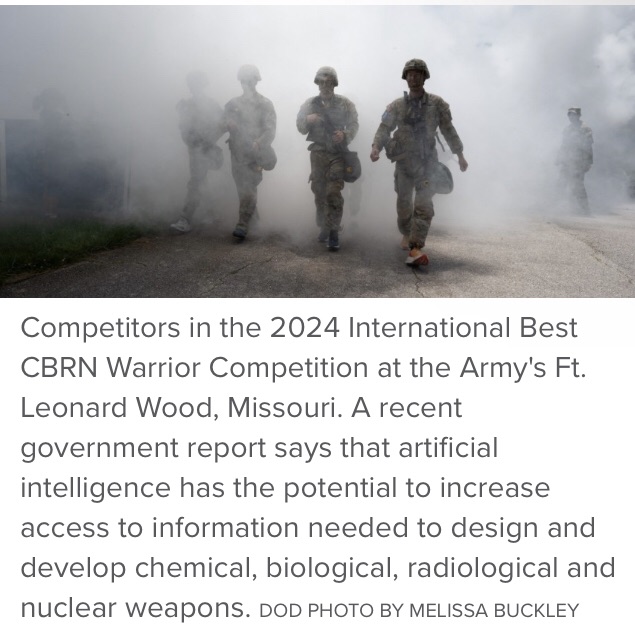
Artificial intelligence has the potential to unlock secrets to the development of weapons of mass destruction, particularly chemical and biological threats, to malicious actors, according to a Department of Homeland Security reportpublicly released last week.

The full report, which was teed up in April with the release of a fact sheet, examines the role of AI in aiding but also thwarting efforts by adversaries to research, develop and use chemical, biological, radiological and nuclear weapons. The report was required under President Joe Biden’s October 2023 executive order on AI.

“The increased proliferation and capabilities of AI tools … may lead to significant changes in the landscape of threats to U.S. national security over time, including by influencing the means, accessibility, or likelihood of a successful CBRN attack,” DHS’s Countering Weapons of Mass Destruction Office states in the report.

According to the report, “known limitations in existing U.S. biological and chemical security regulations and enforcement, when combined with increased use of AI tools, could increase the likelihood of both intentional and unintentional dangerous research outcomes that pose a risk to public health, economic security, or national security.”

Specifically, the report states that the proliferation of publicly available AI tools could lower the barrier to entry for malicious actors seeking information on the composition, development and delivery of chemical and biological weapons. While access to laboratory facilities is still a hurdle, the report notes that so-called “cloud labs” could allow threat actors to remotely develop components of weapons of mass destruction in the physical world, potentially under the cover of anonymity. 

CWMD recommended that the U.S. develop guidance covering the “tactical exclusion and/or protection of sensitive chemical and biological data” from public training materials for large language models, as well as more oversight governing access to remote-controlled lab facilities. 

The report also said that specific federal guidance is needed to govern how biological design tools and biological- and chemical-specific foundation models are used. This guidance would ideally include “granular release practices” for source code and specification for the weight calculations used to build a relevant language model.

More generally, the report seeks the development of consensus within U.S. government regulatory agencies on how to manage AI and machine learning technologies, in particular as they intersect with chemical and biological research.

Other findings include incorporating “safe harbor” vulnerability reporting practices into organizational proceedings, practicing internal evaluation and red teaming efforts, cultivating a broader culture of responsibility among expert life science communities and responsibly investigating the benefits AI and machine learning could have in biological, chemical and nuclear contexts. 

The report also envisions a role for AI in mitigating existing CBRN risks through threat detection and response, including via disease surveillance, diagnostics, “and many other applications the national security and public health communities have not identified.”

While the findings in this report are not enforceable mandates, DHS said that the contents will help shape future policy and objectives within the CWMD office. 

“Moving forward, CWMD will explore how to operationalize the report’s recommendations through existing federal government coordination groups and associated efforts led by the White House,” a DHS spokesperson told Nextgov/FCW. “The Office will integrate AI analysis into established threat and risk assessments as well as into the planning and acquisition that it performs on behalf of federal, state, local, tribal and territorial partners.” 

Article link: https://www.nextgov.com/artificial-intelligence/2024/06/dhs-report-details-ais-potential-amplify-biological-chemical-threats/397607/?

Share this:

  • Click to share on X (Opens in new window) X
  • Click to share on Facebook (Opens in new window) Facebook
  • Click to share on LinkedIn (Opens in new window) LinkedIn
Like Loading...

Related

Posts navigation

← Top 10 Emerging Technologies of 2024 – WEF
The 15 Diseases of Leadership – HBR →
  • Search site

  • Follow healthcarereimagined on WordPress.com
  • Recent Posts

    • Hype Correction – MIT Technology Review 12/15/2025
    • Semantic Collapse – NeurIPS 2025 12/12/2025
    • The arrhythmia of our current age – MIT Technology Review 12/11/2025
    • AI: The Metabolic Mirage 12/09/2025
    • When it all comes crashing down: The aftermath of the AI boom – Bulletin of the Atomic Scientists 12/05/2025
    • Why Digital Transformation—And AI—Demands Systems Thinking – Forbes 12/02/2025
    • How artificial intelligence impacts the US labor market – MIT Sloan 12/01/2025
    • Will quantum computing be chemistry’s next AI? 12/01/2025
    • Ontology is having its moment. 11/28/2025
    • Disconnected Systems Lead to Disconnected Care 11/26/2025
  • Categories

    • Accountable Care Organizations
    • ACOs
    • AHRQ
    • American Board of Internal Medicine
    • Big Data
    • Blue Button
    • Board Certification
    • Cancer Treatment
    • Data Science
    • Digital Services Playbook
    • DoD
    • EHR Interoperability
    • EHR Usability
    • Emergency Medicine
    • FDA
    • FDASIA
    • GAO Reports
    • Genetic Data
    • Genetic Research
    • Genomic Data
    • Global Standards
    • Health Care Costs
    • Health Care Economics
    • Health IT adoption
    • Health Outcomes
    • Healthcare Delivery
    • Healthcare Informatics
    • Healthcare Outcomes
    • Healthcare Security
    • Helathcare Delivery
    • HHS
    • HIPAA
    • ICD-10
    • Innovation
    • Integrated Electronic Health Records
    • IT Acquisition
    • JASONS
    • Lab Report Access
    • Military Health System Reform
    • Mobile Health
    • Mobile Healthcare
    • National Health IT System
    • NSF
    • ONC Reports to Congress
    • Oncology
    • Open Data
    • Patient Centered Medical Home
    • Patient Portals
    • PCMH
    • Precision Medicine
    • Primary Care
    • Public Health
    • Quadruple Aim
    • Quality Measures
    • Rehab Medicine
    • TechFAR Handbook
    • Triple Aim
    • U.S. Air Force Medicine
    • U.S. Army
    • U.S. Army Medicine
    • U.S. Navy Medicine
    • U.S. Surgeon General
    • Uncategorized
    • Value-based Care
    • Veterans Affairs
    • Warrior Transistion Units
    • XPRIZE
  • Archives

    • December 2025 (8)
    • November 2025 (9)
    • October 2025 (10)
    • September 2025 (4)
    • August 2025 (7)
    • July 2025 (2)
    • June 2025 (9)
    • May 2025 (4)
    • April 2025 (11)
    • March 2025 (11)
    • February 2025 (10)
    • January 2025 (12)
    • December 2024 (12)
    • November 2024 (7)
    • October 2024 (5)
    • September 2024 (9)
    • August 2024 (10)
    • July 2024 (13)
    • June 2024 (18)
    • May 2024 (10)
    • April 2024 (19)
    • March 2024 (35)
    • February 2024 (23)
    • January 2024 (16)
    • December 2023 (22)
    • November 2023 (38)
    • October 2023 (24)
    • September 2023 (24)
    • August 2023 (34)
    • July 2023 (33)
    • June 2023 (30)
    • May 2023 (35)
    • April 2023 (30)
    • March 2023 (30)
    • February 2023 (15)
    • January 2023 (17)
    • December 2022 (10)
    • November 2022 (7)
    • October 2022 (22)
    • September 2022 (16)
    • August 2022 (33)
    • July 2022 (28)
    • June 2022 (42)
    • May 2022 (53)
    • April 2022 (35)
    • March 2022 (37)
    • February 2022 (21)
    • January 2022 (28)
    • December 2021 (23)
    • November 2021 (12)
    • October 2021 (10)
    • September 2021 (4)
    • August 2021 (4)
    • July 2021 (4)
    • May 2021 (3)
    • April 2021 (1)
    • March 2021 (2)
    • February 2021 (1)
    • January 2021 (4)
    • December 2020 (7)
    • November 2020 (2)
    • October 2020 (4)
    • September 2020 (7)
    • August 2020 (11)
    • July 2020 (3)
    • June 2020 (5)
    • April 2020 (3)
    • March 2020 (1)
    • February 2020 (1)
    • January 2020 (2)
    • December 2019 (2)
    • November 2019 (1)
    • September 2019 (4)
    • August 2019 (3)
    • July 2019 (5)
    • June 2019 (10)
    • May 2019 (8)
    • April 2019 (6)
    • March 2019 (7)
    • February 2019 (17)
    • January 2019 (14)
    • December 2018 (10)
    • November 2018 (20)
    • October 2018 (14)
    • September 2018 (27)
    • August 2018 (19)
    • July 2018 (16)
    • June 2018 (18)
    • May 2018 (28)
    • April 2018 (3)
    • March 2018 (11)
    • February 2018 (5)
    • January 2018 (10)
    • December 2017 (20)
    • November 2017 (30)
    • October 2017 (33)
    • September 2017 (11)
    • August 2017 (13)
    • July 2017 (9)
    • June 2017 (8)
    • May 2017 (9)
    • April 2017 (4)
    • March 2017 (12)
    • December 2016 (3)
    • September 2016 (4)
    • August 2016 (1)
    • July 2016 (7)
    • June 2016 (7)
    • April 2016 (4)
    • March 2016 (7)
    • February 2016 (1)
    • January 2016 (3)
    • November 2015 (3)
    • October 2015 (2)
    • September 2015 (9)
    • August 2015 (6)
    • June 2015 (5)
    • May 2015 (6)
    • April 2015 (3)
    • March 2015 (16)
    • February 2015 (10)
    • January 2015 (16)
    • December 2014 (9)
    • November 2014 (7)
    • October 2014 (21)
    • September 2014 (8)
    • August 2014 (9)
    • July 2014 (7)
    • June 2014 (5)
    • May 2014 (8)
    • April 2014 (19)
    • March 2014 (8)
    • February 2014 (9)
    • January 2014 (31)
    • December 2013 (23)
    • November 2013 (48)
    • October 2013 (25)
  • Tags

    Business Defense Department Department of Veterans Affairs EHealth EHR Electronic health record Food and Drug Administration Health Health informatics Health Information Exchange Health information technology Health system HIE Hospital IBM Mayo Clinic Medicare Medicine Military Health System Patient Patient portal Patient Protection and Affordable Care Act United States United States Department of Defense United States Department of Veterans Affairs
  • Upcoming Events

Blog at WordPress.com.
  • Reblog
  • Subscribe Subscribed
    • healthcarereimagined
    • Join 154 other subscribers
    • Already have a WordPress.com account? Log in now.
    • healthcarereimagined
    • Subscribe Subscribed
    • Sign up
    • Log in
    • Copy shortlink
    • Report this content
    • View post in Reader
    • Manage subscriptions
    • Collapse this bar
 

Loading Comments...
 

    %d