healthcarereimagined

Envisioning healthcare for the 21st century

  • About
  • Economics

Who should be the head of generative AI — and what they should do – MIT Sloan Management

Posted by timmreardon on 04/27/2024
Posted in: Uncategorized.


by Kara Baskin

 Mar 28, 2024


Adopting artificial intelligence takes time and proper leadership. Heads of generative AI manage how companies use the technology to manage people and help set the right tone. 

Generative artificial intelligence has rapidly become an organizational priority. After it was launched in late 2022, ChatGPT had 100 million active users in less than two months, and many executives now consider managing AI’s impact to be a leadership priority

But adoption takes time and requires proper stewardship. In a recent webinarhosted by MIT Sloan Management Review, London Business School professor Lynda Gratton discussed the new roles companies are creating to guide AI initiatives, the job responsibilities of these leaders, and how companies can use AI for people management.

Introducing the “head of generative AI”

Many companies are introducing positions to guide generative AI use. Last year, Coca-Cola moved Pratik Thakar from his role as head of global creative strategy to senior director of generative AI. Likewise, advertising agency M&C Saatchi named chief data strategy officer James Calvert its new head of generative AI, Gratton noted.

She pinpointed five key job responsibilities for those in these new roles:

  1. Steering the strategic direction and alignment of AI work.
  2. Establishing and sustaining a collaborative generative AI ecosystem.
  3. Monitoring and evaluating generative AI experiments to inform best practices.
  4. Identifying high-impact use cases for scalability.
  5. Overseeing generative AI integration across business units.

Some generative AI leaders might have a creative background; others could come from tech. Gratton said background matters less than a willingness to experiment.

“You want somebody who’s got an experimental mindset, who sees this as a learning opportunity and sees it as an organizational structuring issue,” she said. “The innovation part is what’s really crucial.”

Ways to use AI for people management 

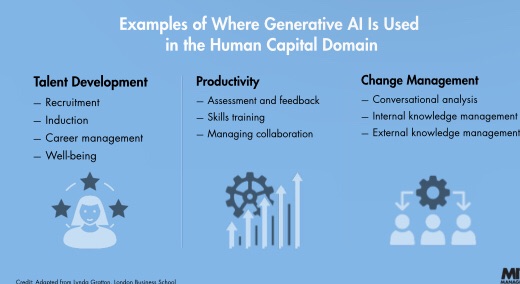
The head of AI could encourage use of the technology to help with managing employees, Gratton said. This encompasses three key areas:

Talent development. Companies can use chatbots and other tools to recruit people and help them manage their careers.

Productivity. AI can be used to create assessments, give feedback, manage collaboration, and provide skills training.

Change management. This includes both internal and external knowledge management. “We have so much knowledge in our organizations … but we don’t know how to find it,” Gratton said. “And it seems to me that this is an area that we’re really focusing on in terms of generative AI.”
Trust, collaboration, and open-mindedness are essential

As companies embark on their generative AI journeys and add leadership in this area, transparency is key.

Leadership insights for innovating amid change3 ways to center humans in artificial intelligence efforts

“Employees need to feel that they trust their managers,” Gratton said. “This isn’t just a piece about technology; it’s also a piece about how you manage change.”

Some workers fear that AI could replace them. A good leader will address those concerns and generate companywide enthusiasm across roles and age groups.

“The CEO and the leadership team have got to set a narrative. When you have high levels of ambiguity, the job of a leader is to tell stories about the future, to help people think: ‘This is where we’re walking; this is why it’s happening; this is how we feel about it,’” she said. This includes getting everyone in the organization involved in thinking about how to use generative AI.

Leaders should remember that buy-in across all career stages and skill levels is essential. Generative AI isn’t just the domain of youth.

“We shouldn’t stereotype the idea that it’s only young people who are thinking about this. In fact, if you look at people at every stage in their working life, they are very interested — and there’s even some data that show the over-50s are really working to experiment and to understand generative AI,” Gratton said. “Don’t be blinkered about what you expect your employees to do.”

Article link: https://mitsloan.mit.edu/ideas-made-to-matter/who-should-be-head-generative-ai-and-what-they-should-do?

Share this:

  • Click to share on X (Opens in new window) X
  • Click to share on Facebook (Opens in new window) Facebook
  • Click to share on LinkedIn (Opens in new window) LinkedIn
Like Loading...

Related

Posts navigation

← AI Report Shows ‘Startlingly Rapid’ Progress—And Ballooning Costs – Scientific American
Analyzing the Rise of AI: Insights from RAND →
  • Search site

  • Follow healthcarereimagined on WordPress.com
  • Recent Posts

    • Hype Correction – MIT Technology Review 12/15/2025
    • Semantic Collapse – NeurIPS 2025 12/12/2025
    • The arrhythmia of our current age – MIT Technology Review 12/11/2025
    • AI: The Metabolic Mirage 12/09/2025
    • When it all comes crashing down: The aftermath of the AI boom – Bulletin of the Atomic Scientists 12/05/2025
    • Why Digital Transformation—And AI—Demands Systems Thinking – Forbes 12/02/2025
    • How artificial intelligence impacts the US labor market – MIT Sloan 12/01/2025
    • Will quantum computing be chemistry’s next AI? 12/01/2025
    • Ontology is having its moment. 11/28/2025
    • Disconnected Systems Lead to Disconnected Care 11/26/2025
  • Categories

    • Accountable Care Organizations
    • ACOs
    • AHRQ
    • American Board of Internal Medicine
    • Big Data
    • Blue Button
    • Board Certification
    • Cancer Treatment
    • Data Science
    • Digital Services Playbook
    • DoD
    • EHR Interoperability
    • EHR Usability
    • Emergency Medicine
    • FDA
    • FDASIA
    • GAO Reports
    • Genetic Data
    • Genetic Research
    • Genomic Data
    • Global Standards
    • Health Care Costs
    • Health Care Economics
    • Health IT adoption
    • Health Outcomes
    • Healthcare Delivery
    • Healthcare Informatics
    • Healthcare Outcomes
    • Healthcare Security
    • Helathcare Delivery
    • HHS
    • HIPAA
    • ICD-10
    • Innovation
    • Integrated Electronic Health Records
    • IT Acquisition
    • JASONS
    • Lab Report Access
    • Military Health System Reform
    • Mobile Health
    • Mobile Healthcare
    • National Health IT System
    • NSF
    • ONC Reports to Congress
    • Oncology
    • Open Data
    • Patient Centered Medical Home
    • Patient Portals
    • PCMH
    • Precision Medicine
    • Primary Care
    • Public Health
    • Quadruple Aim
    • Quality Measures
    • Rehab Medicine
    • TechFAR Handbook
    • Triple Aim
    • U.S. Air Force Medicine
    • U.S. Army
    • U.S. Army Medicine
    • U.S. Navy Medicine
    • U.S. Surgeon General
    • Uncategorized
    • Value-based Care
    • Veterans Affairs
    • Warrior Transistion Units
    • XPRIZE
  • Archives

    • December 2025 (8)
    • November 2025 (9)
    • October 2025 (10)
    • September 2025 (4)
    • August 2025 (7)
    • July 2025 (2)
    • June 2025 (9)
    • May 2025 (4)
    • April 2025 (11)
    • March 2025 (11)
    • February 2025 (10)
    • January 2025 (12)
    • December 2024 (12)
    • November 2024 (7)
    • October 2024 (5)
    • September 2024 (9)
    • August 2024 (10)
    • July 2024 (13)
    • June 2024 (18)
    • May 2024 (10)
    • April 2024 (19)
    • March 2024 (35)
    • February 2024 (23)
    • January 2024 (16)
    • December 2023 (22)
    • November 2023 (38)
    • October 2023 (24)
    • September 2023 (24)
    • August 2023 (34)
    • July 2023 (33)
    • June 2023 (30)
    • May 2023 (35)
    • April 2023 (30)
    • March 2023 (30)
    • February 2023 (15)
    • January 2023 (17)
    • December 2022 (10)
    • November 2022 (7)
    • October 2022 (22)
    • September 2022 (16)
    • August 2022 (33)
    • July 2022 (28)
    • June 2022 (42)
    • May 2022 (53)
    • April 2022 (35)
    • March 2022 (37)
    • February 2022 (21)
    • January 2022 (28)
    • December 2021 (23)
    • November 2021 (12)
    • October 2021 (10)
    • September 2021 (4)
    • August 2021 (4)
    • July 2021 (4)
    • May 2021 (3)
    • April 2021 (1)
    • March 2021 (2)
    • February 2021 (1)
    • January 2021 (4)
    • December 2020 (7)
    • November 2020 (2)
    • October 2020 (4)
    • September 2020 (7)
    • August 2020 (11)
    • July 2020 (3)
    • June 2020 (5)
    • April 2020 (3)
    • March 2020 (1)
    • February 2020 (1)
    • January 2020 (2)
    • December 2019 (2)
    • November 2019 (1)
    • September 2019 (4)
    • August 2019 (3)
    • July 2019 (5)
    • June 2019 (10)
    • May 2019 (8)
    • April 2019 (6)
    • March 2019 (7)
    • February 2019 (17)
    • January 2019 (14)
    • December 2018 (10)
    • November 2018 (20)
    • October 2018 (14)
    • September 2018 (27)
    • August 2018 (19)
    • July 2018 (16)
    • June 2018 (18)
    • May 2018 (28)
    • April 2018 (3)
    • March 2018 (11)
    • February 2018 (5)
    • January 2018 (10)
    • December 2017 (20)
    • November 2017 (30)
    • October 2017 (33)
    • September 2017 (11)
    • August 2017 (13)
    • July 2017 (9)
    • June 2017 (8)
    • May 2017 (9)
    • April 2017 (4)
    • March 2017 (12)
    • December 2016 (3)
    • September 2016 (4)
    • August 2016 (1)
    • July 2016 (7)
    • June 2016 (7)
    • April 2016 (4)
    • March 2016 (7)
    • February 2016 (1)
    • January 2016 (3)
    • November 2015 (3)
    • October 2015 (2)
    • September 2015 (9)
    • August 2015 (6)
    • June 2015 (5)
    • May 2015 (6)
    • April 2015 (3)
    • March 2015 (16)
    • February 2015 (10)
    • January 2015 (16)
    • December 2014 (9)
    • November 2014 (7)
    • October 2014 (21)
    • September 2014 (8)
    • August 2014 (9)
    • July 2014 (7)
    • June 2014 (5)
    • May 2014 (8)
    • April 2014 (19)
    • March 2014 (8)
    • February 2014 (9)
    • January 2014 (31)
    • December 2013 (23)
    • November 2013 (48)
    • October 2013 (25)
  • Tags

    Business Defense Department Department of Veterans Affairs EHealth EHR Electronic health record Food and Drug Administration Health Health informatics Health Information Exchange Health information technology Health system HIE Hospital IBM Mayo Clinic Medicare Medicine Military Health System Patient Patient portal Patient Protection and Affordable Care Act United States United States Department of Defense United States Department of Veterans Affairs
  • Upcoming Events

Blog at WordPress.com.
  • Reblog
  • Subscribe Subscribed
    • healthcarereimagined
    • Join 154 other subscribers
    • Already have a WordPress.com account? Log in now.
    • healthcarereimagined
    • Subscribe Subscribed
    • Sign up
    • Log in
    • Copy shortlink
    • Report this content
    • View post in Reader
    • Manage subscriptions
    • Collapse this bar
 

Loading Comments...
 

    %d