
by Brian Eastwood
Feb 7, 2024
Why It Matters
A new study finds that artificial intelligence is being adopted unevenly in the U.S., with use clustered in large companies and industries such as manufacturing and health care.
It’s not hard to find headlines that suggest artificial intelligence is taking over the business world, from content creation to decision support and process automation.
But reality looks different. A new working paper from the National Bureau of Economic Research about early adoption of AI in the U.S. provides a more nuanced look at which companies are adopting AI, where they are located, and what technologies they are using.
The research shows variation in AI adoption, according to Kristina McElheran, a visiting scholar with the MIT Initiative on the Digital Economy and the paper’s lead author. Just 6% of U.S. companies used AI in 2017, the researchers found, and AI use was concentrated in larger companies and in industries such as manufacturing and information technology. Adoption was also clustered in some “superstar” cities, such as San Francisco, San Antonio, and Nashville.
“The narrative is that AI is everywhere all at once, but the data shows it’s harder to do than people seem interested in discussing,” said McElheran, an assistant professor at the University of Toronto.
“The digital age has arrived, but it has arrived unevenly,” she said.
AI use in America: large companies, certain sectors
Research about AI adoption tends to focus on indirect measures of economic activity that refer to AI use — patents, academic publications, or job descriptions that mention AI, McElheran said.
For a more direct measurement, the researchers joined forces with the U.S. Census Bureau and the National Center for Science and Engineering Statistics to conduct the newly developed Annual Business Survey beginning in 2018. The survey asked firms to describe their use of digital information, cloud computing, types of AI, and other advanced technologies in the prior year. The researchers took data from 447,000 responses from the 2018 survey, linked it to 2017 data in the Census Bureau’s Longitudinal Business Database, and weighted it to represent more than 4 million firms nationwide.
The researchers defined AI adoption as using AI for production — “not in invention, not in aspiration, and not even in commercialization from firms that are selling things that rely on AI,” McElheran said.
The finding that just 6% of companies reported using AI in 2017 is still relevant today, McElheran said, pointing to a November 2023 Census Bureau survey that showed that fewer than 4% of companies use AI to produce goods and services.
The initial, in-depth survey showed other early trends:
- AI use was highest among large companies. More than 50% of companies with more than 5,000 employees were using AI, as were more than 60% of companies with more than 10,000 employees.
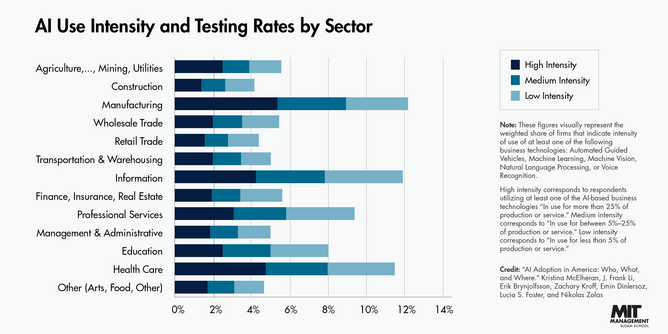
- Use varied among sectors. About 12% of firms in manufacturing, information services, and health care were using AI, compared with 4% in construction and retail.
- AI adoption is happening in some superstar cities, but it has also clustered in some unlikely places. These include manufacturing hubs in the Midwest as well as Southern cities with fewer companies overall than tech hubs in Silicon Valley, the Boston area, or New York City. “Use of AI in production is happening in different places than just the areas that are inventing and commercializing AI-based technologies,” McElheran said.
Startups that embrace AI have younger leaders
To help determine the characteristics of companies that are more likely to use AI, the researchers identified 75,000 startups that participated in the 2018 Annual Business Survey and weighted their responses to represent 740,000 firms.
The researchers found that startups using AI were more likely to have younger, more highly educated, and more highly experienced leaders than startups that were not using AI. Venture capital backing and a focus on process innovation were also associated with AI adoption.
“The firms that have other things going for them tend to be the ones that can leverage bleeding-edge technology like AI,” McElheran said. “The ability to reconfigure how work gets done and how things get made is an important predictor of whether AI is used in production.”
This matters when comparing AI to other types of general-purpose technologies. Innovations such as enterprise software are complex implementations that depend on a completely different set of workflows.
But AI is more similar to a point solution, McElheran said. “At an incremental level, you can transform a given task, or replicate an individual human task,” she said. “It’s not suddenly everywhere all at once.”
This blessing can quickly become a curse, though. Innovate one part of a system, McElheran noted, and the rest of the system needs to innovate at the same pace. Otherwise, “things start to come unglued.” That’s why firms focusing on process innovation — and benefiting from the resources necessary to move process innovation along — are more likely than others to be using AI.
Some of those AI users are in sectors not typically associated with cutting-edge technology, such as manufacturing and health care. The former is closely linked to manufacturing’s use of robotics. The latter stems from a range of use cases, from optimizing operating room schedules to automating back-office coding and billing processes.
AI adoption requires overcoming inertia and adjustment costs
Ultimately, the biggest barriers to AI adoption may be inertia and adjustment costs. This was true with the internet, word processors, and even double-entry bookkeeping. Both factors exist for good reasons, McElheran said, and shouldn’t be discounted.
Routine is embedded in work practices at many companies. “What do you do at the office every Monday morning?” McElheran asked. “Very few people start with a blank slate to redesign the activities that occupy their time and attention. For reasons we’ve known since the steam engine, it takes a while for firms and for people to adjust.” While helpful for day-to-day operations, routines tend to work against change.
Adopting new technology also typical entails costs somewhere. Firms are primed to use it, and consumers are primed to benefit from it, but these gains don’t come for free. Competition can lead to job losses and other economic adjustments. Firms prioritize workers who already possess the skills to use new tech. As noted in another paper co-authored by McElheran, this means workers over age 50 often miss out on the same salary increases their younger colleagues enjoy from digital transformation.
“When we see trends with upside potential, we can’t ignore the dark side that can overturn the aspirations that people have for their jobs and their children” McElheran said. “We need an approach to AI that is realistic and evidence-based about both the benefits and costs for different pockets of the economy and society.”

The paper is authored by McElheran; University of British Columbia professor J. Frank Li; Stanford University professor Erik Brynjolfsson, PhD ’91; and U.S. Census Bureau economists Zachary Kroff, Emin Dinlersoz, Lucia S. Foster, and Nikolas Zolas.
Article link: https://mitsloan.mit.edu/ideas-made-to-matter/who-what-and-where-ai-adoption-america?
 healthcarereimagined