healthcarereimagined

Envisioning healthcare for the 21st century

  • About
  • Economics

When the chips are down: How the semiconductor industry is dealing with a worldwide shortage – WEF

Posted by timmreardon on 04/03/2024
Posted in: Uncategorized.

Feb 9, 2022

Aaron Aboagye

Partner, McKinsey & Company

Ondrej Burkacky

Senior Partner, McKinsey & Company

Abhijit Mahindroo

Partner, McKinsey & Company

Bill Wiseman

Senior Partner, McKinsey & Company

  • Semiconductor chip shortages have been aggravated by the pandemic.
  • Manufacturers are increasing chip production – but the shortfall won’t be resolved immediately.
  • Despite the current problems, the industry remains highly profitable.

When chip shortages first shut down automotive production lines in 2021, the semiconductor industry found itself in an unaccustomed spotlight. Suddenly everyone was talking about the tiny chips that enable so many different car functions, from interior lighting to seat control to blind-spot detection. When some high-tech and consumer-electronics companies began to experience chip shortages or voiced concerns about supply chains, the attention intensified. It’s now clear to all: We are living in a semiconductor world.

But what led to the current dilemma? And what lies ahead for the semiconductor sector and the significant economic value that it generates?

Chip shortage – less supply, more demand

A confluence of problems led to the semiconductor shortage. In addition to long-standing issues within the industry, such as insufficient capacity at semiconductor fabs, the COVID-19 pandemic introduced unprecedented challenges. For instance, automakers cut their chip orders in early 2020 as vehicle sales plummeted. When demand recovered faster than anticipated in the second half of 2020, the semiconductor industry had already shifted production lines to meet demand for other applications. 

Have you read?
  • How fast are semiconductor prices falling?
  • There aren’t enough computer chips to power modern cars
  • What’s the ‘bullwhip effect’ and how can we avoid crises like the global chip shortage?

Semiconductor companies have increased throughput, which will contribute to expected revenue growth of about 9% in 2021 – up from the approximate 5% recorded in 2019, the last pre-pandemic year. Some governments are also upping their investment in semiconductor technology to lessen the impact of global supply-chain disruptions. 

But the current chip shortage is unlikely to be resolved in the near future, partly because of the complexities of the semiconductor production process. Typical lead times can exceed four months for products that are already well established in a manufacturing line (see below). Increasing capacity by moving a product to another manufacturing site usually adds another six months (even in existing plants). Switching to a different manufacturer typically adds another year or more because the chip’s design requires alterations to match the specific manufacturing processes of the new partner. And some chips can contain manufacturer-specific intellectual property that may require alterations or licensing.
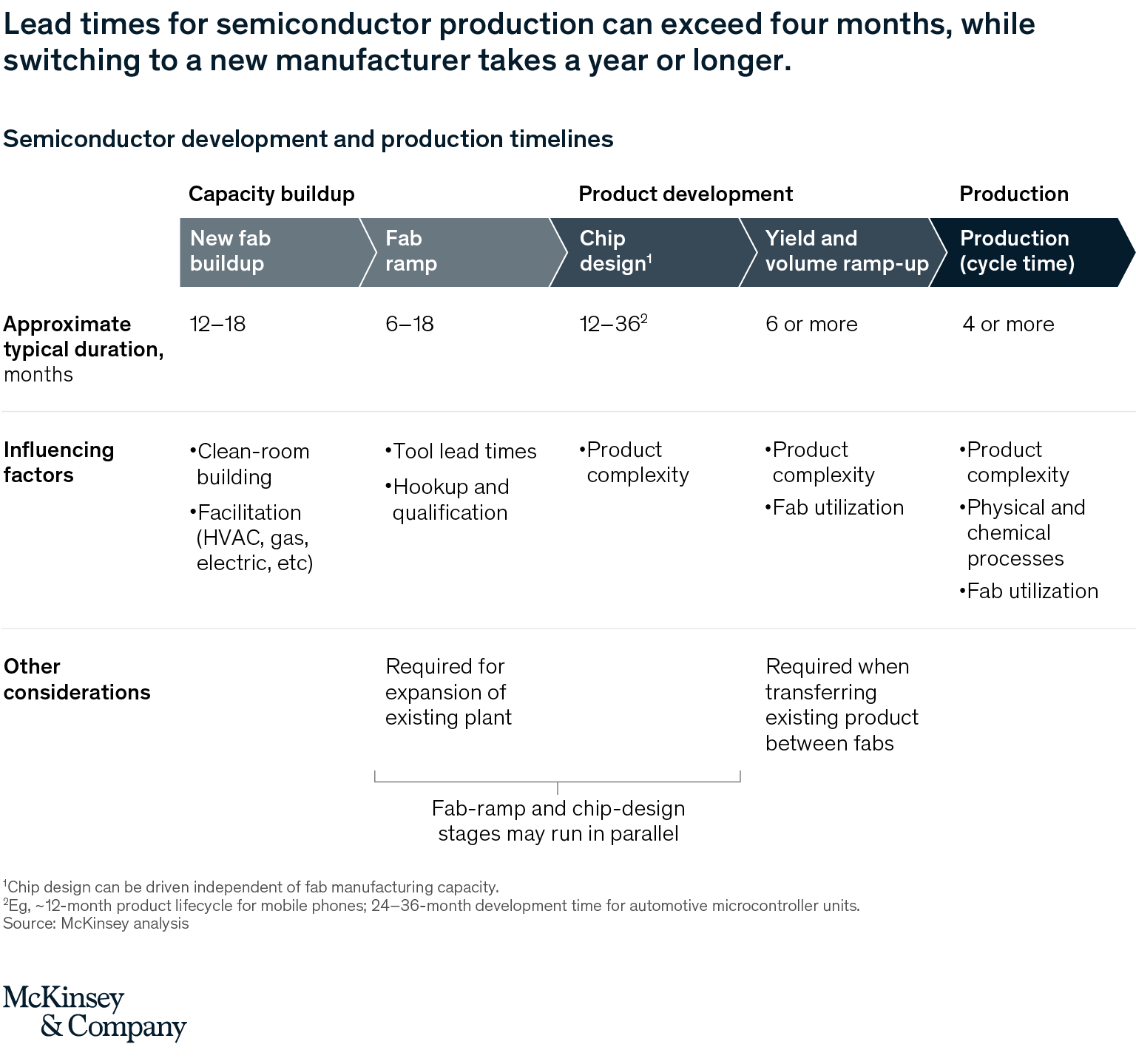
The complexities of semiconductor production mean the current shortage won’t lift immediately Image: McKinsey

The value at stake worldwide

Many companies that need semiconductors are already reconsidering their long-term procurement strategies. Some, for instance, may shift from a “just-in-time” ordering model, which helps minimize inventory costs, to one in which they order semiconductors far in advance. For their part, many semiconductor companies are adjusting their long-standing strategies to remain strong.

The decisions that semiconductor companies make could have enormous economic significance, both for their industry and the economy as a whole. And the stakes have never been higher. In the early 2000s, profit margins were low at semiconductor companies, with most generating returns below the cost of capital. Profitability improved during the past decade, however, spurred by soaring demand for microchips in most industries, the rapid growth of the technology sector, and increased cloud usage, as well as ongoing consolidation in many sub-segments. One consequence is that the semiconductor industry’s profitability has improved significantly relative to other industries, and this trend is expected to continue (see below).

The semiconductor industry has been profitable in recent years Image: McKinsey

As in any industry, value creation varies by product category, so changes in some segments could have a greater impact than others. For instance, memory has been the most profitable segment, followed by fabless companies that design their own chips but outsource their manufacture. Some regional variations are also obvious. North America, home to some of the largest fabless players, accounted for approximately 60% of the global semiconductor value pool during the 2015-19 period. Europe accounted for 4% of the industry’s total economic profit, which accrued primarily to capital-equipment companies. Asia, still the hub for contract chip manufacturing, accounted for the remaining 36%. With this geographic spread, value creation within the semiconductor industry can affect economies worldwide (see below).
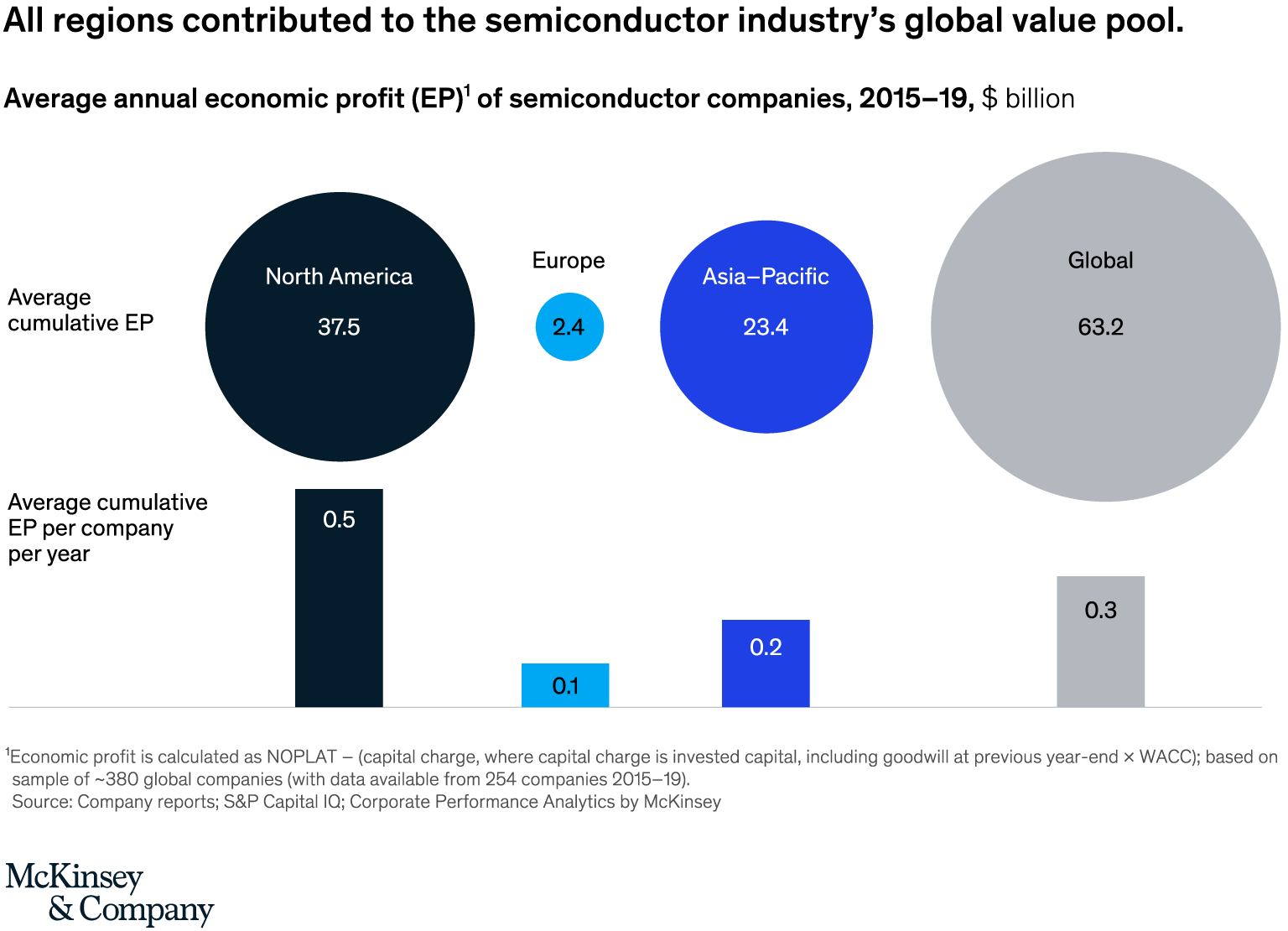
The semiconductor industry has worldwide economic impact Image: McKinsey

Next steps for a critical industry

Capital markets have rewarded the semiconductor industry’s surging profitability, with companies in this sector delivering an annual average of 25% in total returns to shareholders from the end of 2015 to the end of 2019. Last year, shareholders saw even higher returns, averaging 50% per annum, as consumers and businesses upped their purchases of digital equipment of all kinds, partly in response to the COVID-19 pandemic. The question is whether the semiconductor industry can continue delivering such strong returns, especially as the pandemic continues to create uncertainties about demand patterns, supply chains and other issues. 

Beyond increasing production capacity, semiconductor companies could consider several steps to continue their growth and meet customer demand. They could undertake more M&A deals and partnerships to gain an edge in profitable segments and expand their customer base. Semiconductor companies might also increase investments in innovative technologies that will help them develop leading-edge chips for autonomous cars, the internet of things, artificial intelligence, and other areas with burgeoning growth. Above all, more agile strategies may be important during these uncertain times.

No matter what tactics they implement, the decisions that semiconductor companies make will reverberate far beyond their industry to touch the high-tech, consumer goods and automotive companies that depend upon them.

Article link: https://www.weforum.org/agenda/2022/02/semiconductor-chip-shortage-supply-chain/

Share this:

  • Click to share on X (Opens in new window) X
  • Click to share on Facebook (Opens in new window) Facebook
  • Click to share on LinkedIn (Opens in new window) LinkedIn
Like Loading...

Related

Posts navigation

← Microchips – their past, present and future – WEF
Americans Need to Know How the Government Will Use AI – RAND →
  • Search site

  • Follow healthcarereimagined on WordPress.com
  • Recent Posts

    • Hype Correction – MIT Technology Review 12/15/2025
    • Semantic Collapse – NeurIPS 2025 12/12/2025
    • The arrhythmia of our current age – MIT Technology Review 12/11/2025
    • AI: The Metabolic Mirage 12/09/2025
    • When it all comes crashing down: The aftermath of the AI boom – Bulletin of the Atomic Scientists 12/05/2025
    • Why Digital Transformation—And AI—Demands Systems Thinking – Forbes 12/02/2025
    • How artificial intelligence impacts the US labor market – MIT Sloan 12/01/2025
    • Will quantum computing be chemistry’s next AI? 12/01/2025
    • Ontology is having its moment. 11/28/2025
    • Disconnected Systems Lead to Disconnected Care 11/26/2025
  • Categories

    • Accountable Care Organizations
    • ACOs
    • AHRQ
    • American Board of Internal Medicine
    • Big Data
    • Blue Button
    • Board Certification
    • Cancer Treatment
    • Data Science
    • Digital Services Playbook
    • DoD
    • EHR Interoperability
    • EHR Usability
    • Emergency Medicine
    • FDA
    • FDASIA
    • GAO Reports
    • Genetic Data
    • Genetic Research
    • Genomic Data
    • Global Standards
    • Health Care Costs
    • Health Care Economics
    • Health IT adoption
    • Health Outcomes
    • Healthcare Delivery
    • Healthcare Informatics
    • Healthcare Outcomes
    • Healthcare Security
    • Helathcare Delivery
    • HHS
    • HIPAA
    • ICD-10
    • Innovation
    • Integrated Electronic Health Records
    • IT Acquisition
    • JASONS
    • Lab Report Access
    • Military Health System Reform
    • Mobile Health
    • Mobile Healthcare
    • National Health IT System
    • NSF
    • ONC Reports to Congress
    • Oncology
    • Open Data
    • Patient Centered Medical Home
    • Patient Portals
    • PCMH
    • Precision Medicine
    • Primary Care
    • Public Health
    • Quadruple Aim
    • Quality Measures
    • Rehab Medicine
    • TechFAR Handbook
    • Triple Aim
    • U.S. Air Force Medicine
    • U.S. Army
    • U.S. Army Medicine
    • U.S. Navy Medicine
    • U.S. Surgeon General
    • Uncategorized
    • Value-based Care
    • Veterans Affairs
    • Warrior Transistion Units
    • XPRIZE
  • Archives

    • December 2025 (8)
    • November 2025 (9)
    • October 2025 (10)
    • September 2025 (4)
    • August 2025 (7)
    • July 2025 (2)
    • June 2025 (9)
    • May 2025 (4)
    • April 2025 (11)
    • March 2025 (11)
    • February 2025 (10)
    • January 2025 (12)
    • December 2024 (12)
    • November 2024 (7)
    • October 2024 (5)
    • September 2024 (9)
    • August 2024 (10)
    • July 2024 (13)
    • June 2024 (18)
    • May 2024 (10)
    • April 2024 (19)
    • March 2024 (35)
    • February 2024 (23)
    • January 2024 (16)
    • December 2023 (22)
    • November 2023 (38)
    • October 2023 (24)
    • September 2023 (24)
    • August 2023 (34)
    • July 2023 (33)
    • June 2023 (30)
    • May 2023 (35)
    • April 2023 (30)
    • March 2023 (30)
    • February 2023 (15)
    • January 2023 (17)
    • December 2022 (10)
    • November 2022 (7)
    • October 2022 (22)
    • September 2022 (16)
    • August 2022 (33)
    • July 2022 (28)
    • June 2022 (42)
    • May 2022 (53)
    • April 2022 (35)
    • March 2022 (37)
    • February 2022 (21)
    • January 2022 (28)
    • December 2021 (23)
    • November 2021 (12)
    • October 2021 (10)
    • September 2021 (4)
    • August 2021 (4)
    • July 2021 (4)
    • May 2021 (3)
    • April 2021 (1)
    • March 2021 (2)
    • February 2021 (1)
    • January 2021 (4)
    • December 2020 (7)
    • November 2020 (2)
    • October 2020 (4)
    • September 2020 (7)
    • August 2020 (11)
    • July 2020 (3)
    • June 2020 (5)
    • April 2020 (3)
    • March 2020 (1)
    • February 2020 (1)
    • January 2020 (2)
    • December 2019 (2)
    • November 2019 (1)
    • September 2019 (4)
    • August 2019 (3)
    • July 2019 (5)
    • June 2019 (10)
    • May 2019 (8)
    • April 2019 (6)
    • March 2019 (7)
    • February 2019 (17)
    • January 2019 (14)
    • December 2018 (10)
    • November 2018 (20)
    • October 2018 (14)
    • September 2018 (27)
    • August 2018 (19)
    • July 2018 (16)
    • June 2018 (18)
    • May 2018 (28)
    • April 2018 (3)
    • March 2018 (11)
    • February 2018 (5)
    • January 2018 (10)
    • December 2017 (20)
    • November 2017 (30)
    • October 2017 (33)
    • September 2017 (11)
    • August 2017 (13)
    • July 2017 (9)
    • June 2017 (8)
    • May 2017 (9)
    • April 2017 (4)
    • March 2017 (12)
    • December 2016 (3)
    • September 2016 (4)
    • August 2016 (1)
    • July 2016 (7)
    • June 2016 (7)
    • April 2016 (4)
    • March 2016 (7)
    • February 2016 (1)
    • January 2016 (3)
    • November 2015 (3)
    • October 2015 (2)
    • September 2015 (9)
    • August 2015 (6)
    • June 2015 (5)
    • May 2015 (6)
    • April 2015 (3)
    • March 2015 (16)
    • February 2015 (10)
    • January 2015 (16)
    • December 2014 (9)
    • November 2014 (7)
    • October 2014 (21)
    • September 2014 (8)
    • August 2014 (9)
    • July 2014 (7)
    • June 2014 (5)
    • May 2014 (8)
    • April 2014 (19)
    • March 2014 (8)
    • February 2014 (9)
    • January 2014 (31)
    • December 2013 (23)
    • November 2013 (48)
    • October 2013 (25)
  • Tags

    Business Defense Department Department of Veterans Affairs EHealth EHR Electronic health record Food and Drug Administration Health Health informatics Health Information Exchange Health information technology Health system HIE Hospital IBM Mayo Clinic Medicare Medicine Military Health System Patient Patient portal Patient Protection and Affordable Care Act United States United States Department of Defense United States Department of Veterans Affairs
  • Upcoming Events

Blog at WordPress.com.
  • Reblog
  • Subscribe Subscribed
    • healthcarereimagined
    • Join 154 other subscribers
    • Already have a WordPress.com account? Log in now.
    • healthcarereimagined
    • Subscribe Subscribed
    • Sign up
    • Log in
    • Copy shortlink
    • Report this content
    • View post in Reader
    • Manage subscriptions
    • Collapse this bar
 

Loading Comments...
 

    %d