healthcarereimagined

Envisioning healthcare for the 21st century

  • About
  • Economics

Human operators must be held accountable for AI’s use in conflicts, Air Force secretary says – Nextgov

Posted by timmreardon on 12/07/2023
Posted in: Uncategorized.

By EDWARD GRAHAMDECEMBER 4, 2023

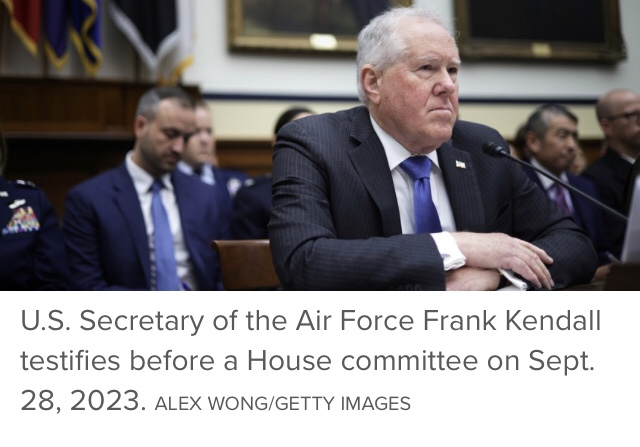
The Pentagon needs “to find a way to hold people accountable” for what artificial intelligence technologies do in future conflicts, according to Air Force Secretary Frank Kendall.

Humans will ultimately be held responsible for the use or misuse of artificial intelligence technologies during military conflicts, a top Department of Defense official said during a panel discussion at the Reagan National Defense Forum on Saturday.

Air Force Secretary Frank Kendall dismissed the notion “of the rogue robot that goes out there and runs around and shoots everything in sight indiscriminately,” highlighting the fact that AI technologies — particularly those deployed on the battlefields of the future — will be governed by some level of human oversight.

“I care a lot about civil society and the rule of law, including laws of armed conflict,” he said. “Our policies are written around compliance with those laws. You don’t enforce laws against machines; you enforce them against people. And I think our challenge is not to somehow limit what we can do with AI, but it’s to find a way to hold people accountable for what the AI does.”

Even as the Pentagon continues to experiment with AI, the department has worked to establish safeguards around its use of the technologies. DOD updated its decades-old policy on autonomous weapons in February to clarify, in part, that weapons with AI-enabled capabilities need to follow the department’s AI guidelines. 

The Pentagon previously issued a series of ethical AI principles in 2020 governing its use of the technologies, and released a data, analytics and AI adoption strategy in November that positioned quality of data as key to the department’s implementation of the advanced tech.

The goal for now, Kendall said, is to build confidence and trust in the technology and then “get it into field capabilities as quickly as we can.” 

“The critical parameter on the battlefield is time,” he added. “And AI will be able to do much more complicated things much more accurately and much faster than human beings can.”

Kendall pointed to two specific mistakes that AI could make “in a lethal area,” including not engaging a target that it should have engaged or engaging civilian targets and U.S. military assets and allies. These possibilities, he said, necessitate more defined rules for holding operators responsible when they do occur. 

“We are still going to have to find ways to manage this technology, manage its application and hold human beings accountable for when it doesn’t comply with the rules that we already have,” he added. “I think that’s the approach we need to take.”

For the time being, however, the Pentagon’s uses of AI are largely focused on processing large amounts of data for more administrative-oriented tasks.

For the time being, however, the Pentagon’s uses of AI are largely focused on processing large amounts of data for more administrative-oriented tasks.

“There are enormous possibilities here, but it is not anywhere near general human intelligence equivalents,” Kendall said, citing pattern recognition and “deep data analytics to associate things from an intelligence perspective” as AI’s most effective applications.

During a discussion last month, Schuyler Moore — the chief technology officer for U.S. Central Command — cited AI’s uneven performance and said that during military conflicts, officials “will more frequently than not put it to the side or use it in very, very select contexts where we feel very certain of the risks associated.”

But concerns still remain about how these tools will ultimately be used to enhance future warfighting capabilities, and the specific policies that are needed to enforce safeguards.

Rep. Mike Gallagher, R-Wis. — who chairs the House Select Committee on the Chinese Communist Party and was a former co-chair of the Cyberspace Solarium Commission — said “we need to have a plan for whether and how we are going to quickly adopt [AI] across multiple battlefield domains and warfighting capabilities.” 

“I’m not sure we’ve thought through that,” Gallagher added.

Article link: https://www.nextgov.com/artificial-intelligence/2023/12/human-operators-must-be-held-accountable-ais-use-conflicts-air-force-secretary-says/392457/?

Share this:

  • Click to share on X (Opens in new window) X
  • Click to share on Facebook (Opens in new window) Facebook
  • Click to share on LinkedIn (Opens in new window) LinkedIn
Like Loading...

Related

Posts navigation

← Bipartisan bill strives for ‘more nimble and meaningful’ federal contracting – Nextgov
The Evolution Of AI: From IBM And AWS To OpenAI and Anthropic – Forbes →
  • Search site

  • Follow healthcarereimagined on WordPress.com
  • Recent Posts

    • Hype Correction – MIT Technology Review 12/15/2025
    • Semantic Collapse – NeurIPS 2025 12/12/2025
    • The arrhythmia of our current age – MIT Technology Review 12/11/2025
    • AI: The Metabolic Mirage 12/09/2025
    • When it all comes crashing down: The aftermath of the AI boom – Bulletin of the Atomic Scientists 12/05/2025
    • Why Digital Transformation—And AI—Demands Systems Thinking – Forbes 12/02/2025
    • How artificial intelligence impacts the US labor market – MIT Sloan 12/01/2025
    • Will quantum computing be chemistry’s next AI? 12/01/2025
    • Ontology is having its moment. 11/28/2025
    • Disconnected Systems Lead to Disconnected Care 11/26/2025
  • Categories

    • Accountable Care Organizations
    • ACOs
    • AHRQ
    • American Board of Internal Medicine
    • Big Data
    • Blue Button
    • Board Certification
    • Cancer Treatment
    • Data Science
    • Digital Services Playbook
    • DoD
    • EHR Interoperability
    • EHR Usability
    • Emergency Medicine
    • FDA
    • FDASIA
    • GAO Reports
    • Genetic Data
    • Genetic Research
    • Genomic Data
    • Global Standards
    • Health Care Costs
    • Health Care Economics
    • Health IT adoption
    • Health Outcomes
    • Healthcare Delivery
    • Healthcare Informatics
    • Healthcare Outcomes
    • Healthcare Security
    • Helathcare Delivery
    • HHS
    • HIPAA
    • ICD-10
    • Innovation
    • Integrated Electronic Health Records
    • IT Acquisition
    • JASONS
    • Lab Report Access
    • Military Health System Reform
    • Mobile Health
    • Mobile Healthcare
    • National Health IT System
    • NSF
    • ONC Reports to Congress
    • Oncology
    • Open Data
    • Patient Centered Medical Home
    • Patient Portals
    • PCMH
    • Precision Medicine
    • Primary Care
    • Public Health
    • Quadruple Aim
    • Quality Measures
    • Rehab Medicine
    • TechFAR Handbook
    • Triple Aim
    • U.S. Air Force Medicine
    • U.S. Army
    • U.S. Army Medicine
    • U.S. Navy Medicine
    • U.S. Surgeon General
    • Uncategorized
    • Value-based Care
    • Veterans Affairs
    • Warrior Transistion Units
    • XPRIZE
  • Archives

    • December 2025 (8)
    • November 2025 (9)
    • October 2025 (10)
    • September 2025 (4)
    • August 2025 (7)
    • July 2025 (2)
    • June 2025 (9)
    • May 2025 (4)
    • April 2025 (11)
    • March 2025 (11)
    • February 2025 (10)
    • January 2025 (12)
    • December 2024 (12)
    • November 2024 (7)
    • October 2024 (5)
    • September 2024 (9)
    • August 2024 (10)
    • July 2024 (13)
    • June 2024 (18)
    • May 2024 (10)
    • April 2024 (19)
    • March 2024 (35)
    • February 2024 (23)
    • January 2024 (16)
    • December 2023 (22)
    • November 2023 (38)
    • October 2023 (24)
    • September 2023 (24)
    • August 2023 (34)
    • July 2023 (33)
    • June 2023 (30)
    • May 2023 (35)
    • April 2023 (30)
    • March 2023 (30)
    • February 2023 (15)
    • January 2023 (17)
    • December 2022 (10)
    • November 2022 (7)
    • October 2022 (22)
    • September 2022 (16)
    • August 2022 (33)
    • July 2022 (28)
    • June 2022 (42)
    • May 2022 (53)
    • April 2022 (35)
    • March 2022 (37)
    • February 2022 (21)
    • January 2022 (28)
    • December 2021 (23)
    • November 2021 (12)
    • October 2021 (10)
    • September 2021 (4)
    • August 2021 (4)
    • July 2021 (4)
    • May 2021 (3)
    • April 2021 (1)
    • March 2021 (2)
    • February 2021 (1)
    • January 2021 (4)
    • December 2020 (7)
    • November 2020 (2)
    • October 2020 (4)
    • September 2020 (7)
    • August 2020 (11)
    • July 2020 (3)
    • June 2020 (5)
    • April 2020 (3)
    • March 2020 (1)
    • February 2020 (1)
    • January 2020 (2)
    • December 2019 (2)
    • November 2019 (1)
    • September 2019 (4)
    • August 2019 (3)
    • July 2019 (5)
    • June 2019 (10)
    • May 2019 (8)
    • April 2019 (6)
    • March 2019 (7)
    • February 2019 (17)
    • January 2019 (14)
    • December 2018 (10)
    • November 2018 (20)
    • October 2018 (14)
    • September 2018 (27)
    • August 2018 (19)
    • July 2018 (16)
    • June 2018 (18)
    • May 2018 (28)
    • April 2018 (3)
    • March 2018 (11)
    • February 2018 (5)
    • January 2018 (10)
    • December 2017 (20)
    • November 2017 (30)
    • October 2017 (33)
    • September 2017 (11)
    • August 2017 (13)
    • July 2017 (9)
    • June 2017 (8)
    • May 2017 (9)
    • April 2017 (4)
    • March 2017 (12)
    • December 2016 (3)
    • September 2016 (4)
    • August 2016 (1)
    • July 2016 (7)
    • June 2016 (7)
    • April 2016 (4)
    • March 2016 (7)
    • February 2016 (1)
    • January 2016 (3)
    • November 2015 (3)
    • October 2015 (2)
    • September 2015 (9)
    • August 2015 (6)
    • June 2015 (5)
    • May 2015 (6)
    • April 2015 (3)
    • March 2015 (16)
    • February 2015 (10)
    • January 2015 (16)
    • December 2014 (9)
    • November 2014 (7)
    • October 2014 (21)
    • September 2014 (8)
    • August 2014 (9)
    • July 2014 (7)
    • June 2014 (5)
    • May 2014 (8)
    • April 2014 (19)
    • March 2014 (8)
    • February 2014 (9)
    • January 2014 (31)
    • December 2013 (23)
    • November 2013 (48)
    • October 2013 (25)
  • Tags

    Business Defense Department Department of Veterans Affairs EHealth EHR Electronic health record Food and Drug Administration Health Health informatics Health Information Exchange Health information technology Health system HIE Hospital IBM Mayo Clinic Medicare Medicine Military Health System Patient Patient portal Patient Protection and Affordable Care Act United States United States Department of Defense United States Department of Veterans Affairs
  • Upcoming Events

Blog at WordPress.com.
  • Reblog
  • Subscribe Subscribed
    • healthcarereimagined
    • Join 154 other subscribers
    • Already have a WordPress.com account? Log in now.
    • healthcarereimagined
    • Subscribe Subscribed
    • Sign up
    • Log in
    • Copy shortlink
    • Report this content
    • View post in Reader
    • Manage subscriptions
    • Collapse this bar
 

Loading Comments...
 

    %d