healthcarereimagined

Envisioning healthcare for the 21st century

  • About
  • Economics

New kind of quantum computer made using high-resolution microscope – Nature

Posted by timmreardon on 10/09/2023
Posted in: Uncategorized.

Individual atoms on a surface do their first basic calculation.
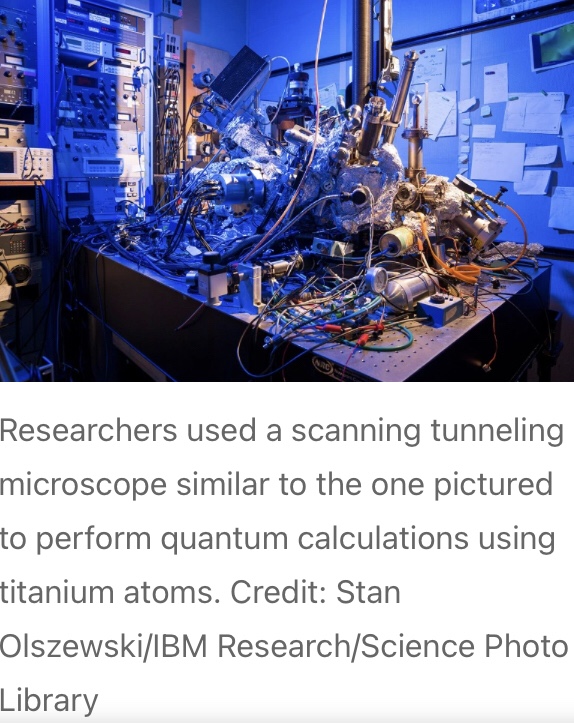
Physicists have performed the first quantum calculations to be carried out using individual atoms sitting on a surface.

The technique, described on 5 October in Science1, controls titanium atoms by beaming microwave signals from the tip of a scanning tunnelling microscope (STM). It is unlikely to compete any time soon with the leading approaches to quantum computing, including those adopted by Google and IBM, as well as by many start-up companies. But the tactic could be used to study quantum properties in a variety of other chemical elements or even molecules, say the researchers who developed it.

At some level, everything in nature is quantum and can, in principle, perform quantum computations. The hard part is to isolate quantum states called qubits — the quantum equivalent of the memory bits in a classical computer — from environmental disturbances, and to control them finely enough for such calculations to be achieved.

Andreas Heinrich at the Institute for Basic Science in Seoul and his collaborators worked with nature’s ‘original’ qubit — the spin of the electron. Electrons act like tiny compass needles, and measuring the direction of their spin can yield only two possible values, ‘up’ or ‘down’, which correspond to the ‘0’ and ‘1’ of a classical bit. But before it is measured, electron spin can exist in a continuum of possible intermediate states, called superpositions. This is the key to performing quantum computations.
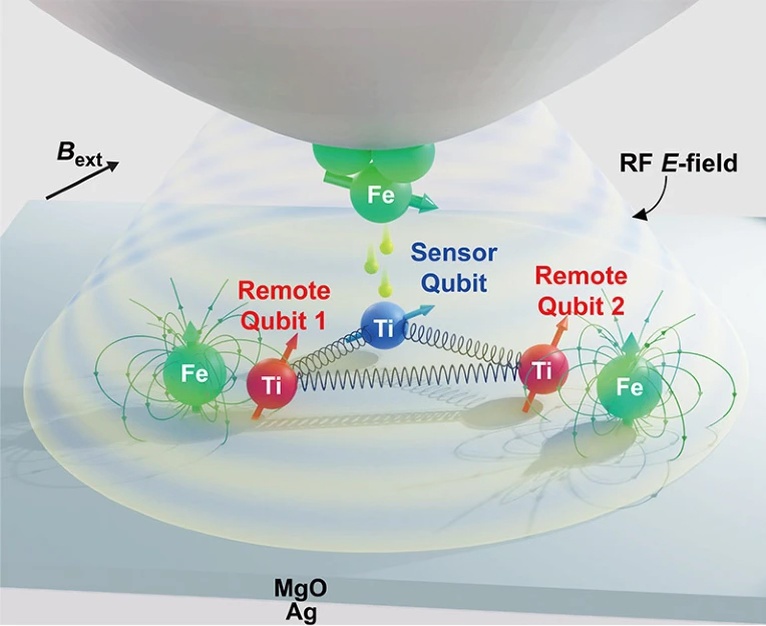
Three titanium atoms are arranged inside a scanning tunnelling microscope (STM), close enough to sense each other’s quantum spins. Iron atoms stuck to the tip of the STM (top) ‘talk’ with one of the qubits (blue), using it to read and write information on the other two (red) and to get them to perform a rudimentary quantum computation.Credit: Center for Quantum Nanoscience

The researchers started by scattering titanium atoms on a perfectly flat surface made of magnesium oxide. They then mapped the atoms’ positions using the STM, which has atomic resolution. They used the tip of the STM probe to move the titanium atoms around, arranging three of them into a triangle.

Using microwave signals emitted from the STM tip, the researchers were able to control the spin of a single electron in one of the titanium atoms. By tuning the frequencies of the microwaves appropriately, they could also make its spin interact with the spins in the other two titanium atoms, similarly to how multiple compass needles can influence each other through their magnetic fields. By doing this, the team was able to set up a simple two-qubit quantum operation, and also to read out its results. The operation took just nanoseconds — faster than is possible with most other types of qubit.

Heinrich says that it will be fairly straightforward to extend the technique to perhaps 100 qubits, possibly by manipulating spins in a combination of individual atoms and molecules. It might be difficult to push it much beyond that, however — and the leading qubit technologies are already being scaled up to hundreds of qubits. “We are more on the basic-science side,” Heinrich says, although he adds that multiple STM quantum computers could one day be linked to form a bigger one.

doi: https://doi.org/10.1038/d41586-023-03141-z

Article link: https://www.nature.com/articles/d41586-023-03141-z

References

  1. Wang, Y. et al. Science 382, 87–92 (2023).Article Google Scholar 

Download references

Share this:

  • Click to share on X (Opens in new window) X
  • Click to share on Facebook (Opens in new window) Facebook
  • Click to share on LinkedIn (Opens in new window) LinkedIn
Like Loading...

Related

Posts navigation

← The Role of Culture in Enabling Change
Google Adopts Passkeys as Default Sign-in for All Users →
  • Search site

  • Follow healthcarereimagined on WordPress.com
  • Recent Posts

    • Hype Correction – MIT Technology Review 12/15/2025
    • Semantic Collapse – NeurIPS 2025 12/12/2025
    • The arrhythmia of our current age – MIT Technology Review 12/11/2025
    • AI: The Metabolic Mirage 12/09/2025
    • When it all comes crashing down: The aftermath of the AI boom – Bulletin of the Atomic Scientists 12/05/2025
    • Why Digital Transformation—And AI—Demands Systems Thinking – Forbes 12/02/2025
    • How artificial intelligence impacts the US labor market – MIT Sloan 12/01/2025
    • Will quantum computing be chemistry’s next AI? 12/01/2025
    • Ontology is having its moment. 11/28/2025
    • Disconnected Systems Lead to Disconnected Care 11/26/2025
  • Categories

    • Accountable Care Organizations
    • ACOs
    • AHRQ
    • American Board of Internal Medicine
    • Big Data
    • Blue Button
    • Board Certification
    • Cancer Treatment
    • Data Science
    • Digital Services Playbook
    • DoD
    • EHR Interoperability
    • EHR Usability
    • Emergency Medicine
    • FDA
    • FDASIA
    • GAO Reports
    • Genetic Data
    • Genetic Research
    • Genomic Data
    • Global Standards
    • Health Care Costs
    • Health Care Economics
    • Health IT adoption
    • Health Outcomes
    • Healthcare Delivery
    • Healthcare Informatics
    • Healthcare Outcomes
    • Healthcare Security
    • Helathcare Delivery
    • HHS
    • HIPAA
    • ICD-10
    • Innovation
    • Integrated Electronic Health Records
    • IT Acquisition
    • JASONS
    • Lab Report Access
    • Military Health System Reform
    • Mobile Health
    • Mobile Healthcare
    • National Health IT System
    • NSF
    • ONC Reports to Congress
    • Oncology
    • Open Data
    • Patient Centered Medical Home
    • Patient Portals
    • PCMH
    • Precision Medicine
    • Primary Care
    • Public Health
    • Quadruple Aim
    • Quality Measures
    • Rehab Medicine
    • TechFAR Handbook
    • Triple Aim
    • U.S. Air Force Medicine
    • U.S. Army
    • U.S. Army Medicine
    • U.S. Navy Medicine
    • U.S. Surgeon General
    • Uncategorized
    • Value-based Care
    • Veterans Affairs
    • Warrior Transistion Units
    • XPRIZE
  • Archives

    • December 2025 (8)
    • November 2025 (9)
    • October 2025 (10)
    • September 2025 (4)
    • August 2025 (7)
    • July 2025 (2)
    • June 2025 (9)
    • May 2025 (4)
    • April 2025 (11)
    • March 2025 (11)
    • February 2025 (10)
    • January 2025 (12)
    • December 2024 (12)
    • November 2024 (7)
    • October 2024 (5)
    • September 2024 (9)
    • August 2024 (10)
    • July 2024 (13)
    • June 2024 (18)
    • May 2024 (10)
    • April 2024 (19)
    • March 2024 (35)
    • February 2024 (23)
    • January 2024 (16)
    • December 2023 (22)
    • November 2023 (38)
    • October 2023 (24)
    • September 2023 (24)
    • August 2023 (34)
    • July 2023 (33)
    • June 2023 (30)
    • May 2023 (35)
    • April 2023 (30)
    • March 2023 (30)
    • February 2023 (15)
    • January 2023 (17)
    • December 2022 (10)
    • November 2022 (7)
    • October 2022 (22)
    • September 2022 (16)
    • August 2022 (33)
    • July 2022 (28)
    • June 2022 (42)
    • May 2022 (53)
    • April 2022 (35)
    • March 2022 (37)
    • February 2022 (21)
    • January 2022 (28)
    • December 2021 (23)
    • November 2021 (12)
    • October 2021 (10)
    • September 2021 (4)
    • August 2021 (4)
    • July 2021 (4)
    • May 2021 (3)
    • April 2021 (1)
    • March 2021 (2)
    • February 2021 (1)
    • January 2021 (4)
    • December 2020 (7)
    • November 2020 (2)
    • October 2020 (4)
    • September 2020 (7)
    • August 2020 (11)
    • July 2020 (3)
    • June 2020 (5)
    • April 2020 (3)
    • March 2020 (1)
    • February 2020 (1)
    • January 2020 (2)
    • December 2019 (2)
    • November 2019 (1)
    • September 2019 (4)
    • August 2019 (3)
    • July 2019 (5)
    • June 2019 (10)
    • May 2019 (8)
    • April 2019 (6)
    • March 2019 (7)
    • February 2019 (17)
    • January 2019 (14)
    • December 2018 (10)
    • November 2018 (20)
    • October 2018 (14)
    • September 2018 (27)
    • August 2018 (19)
    • July 2018 (16)
    • June 2018 (18)
    • May 2018 (28)
    • April 2018 (3)
    • March 2018 (11)
    • February 2018 (5)
    • January 2018 (10)
    • December 2017 (20)
    • November 2017 (30)
    • October 2017 (33)
    • September 2017 (11)
    • August 2017 (13)
    • July 2017 (9)
    • June 2017 (8)
    • May 2017 (9)
    • April 2017 (4)
    • March 2017 (12)
    • December 2016 (3)
    • September 2016 (4)
    • August 2016 (1)
    • July 2016 (7)
    • June 2016 (7)
    • April 2016 (4)
    • March 2016 (7)
    • February 2016 (1)
    • January 2016 (3)
    • November 2015 (3)
    • October 2015 (2)
    • September 2015 (9)
    • August 2015 (6)
    • June 2015 (5)
    • May 2015 (6)
    • April 2015 (3)
    • March 2015 (16)
    • February 2015 (10)
    • January 2015 (16)
    • December 2014 (9)
    • November 2014 (7)
    • October 2014 (21)
    • September 2014 (8)
    • August 2014 (9)
    • July 2014 (7)
    • June 2014 (5)
    • May 2014 (8)
    • April 2014 (19)
    • March 2014 (8)
    • February 2014 (9)
    • January 2014 (31)
    • December 2013 (23)
    • November 2013 (48)
    • October 2013 (25)
  • Tags

    Business Defense Department Department of Veterans Affairs EHealth EHR Electronic health record Food and Drug Administration Health Health informatics Health Information Exchange Health information technology Health system HIE Hospital IBM Mayo Clinic Medicare Medicine Military Health System Patient Patient portal Patient Protection and Affordable Care Act United States United States Department of Defense United States Department of Veterans Affairs
  • Upcoming Events

Blog at WordPress.com.
  • Reblog
  • Subscribe Subscribed
    • healthcarereimagined
    • Join 154 other subscribers
    • Already have a WordPress.com account? Log in now.
    • healthcarereimagined
    • Subscribe Subscribed
    • Sign up
    • Log in
    • Copy shortlink
    • Report this content
    • View post in Reader
    • Manage subscriptions
    • Collapse this bar
 

Loading Comments...
 

    %d