30 years after its launch, the world wide web now connects 1.7 billion websites
Learn more about the future of the web: http://ow.ly/Vyoq50OgW6q
@CERN
Adrian Ma
Assistant Professor, Journalism, Toronto Metropolitan University

- Web3 is envisioned to be a “decentralized web ecosystem,” in which users can retain ownership of their data.
- Its blockchain-based infrastructure would usher in the era of the “token economy”, say experts.
- Web3 and Web 3.0 – in which a collection of websites would be linked together at the data level – are often mixed up, explains The Conversation.
The rapid growth of cryptocurrencies and virtual non-fungible tokens have dominated news headlines in recent years. But not many may see how these modish applications connect together in a wider idea being touted by some as the next iteration of the internet — Web3.
There are many misconceptions surrounding this buzzy (and, frankly, fuzzy) term, including the conflation of Web3 with Web 3.0. Here’s what you need to know about these terms.
What is Web3?
Since Web3 is still a developing movement, there’s no universal agreement among experts about its definition. Simply put, Web3 is envisioned to be a “decentralized web ecosystem,” empowering users to bypass internet gatekeepers and retain ownership of their data.
This would be done through blockchain; rather than relying on single servers and centralized databases, Web3 would run off of public ledgers where data is stored on computer networks that are chained together.
A decentralized Web3 would fundamentally change how the internet operates — financial institutions and tech companies would no longer need to be intermediaries of our online experiences.
As one business reporter put it:
“In a Web3 world, people control their own data and bounce around from social media to email to shopping using a single personalized account, creating a public record on the blockchain of all of that activity.”
Web3’s blockchain-based infrastructure would open up intriguing possibilities by ushering in the era of the “token economy.” The token economy would allow users to monetize their data by providing them with tokens for their online interactions. These tokens could offer users perks or benefits, including ownership stakes in content platforms or voting rights in online communities.
To better understand Web3, it helps to step back and see how the internet developed into what it is now.
Web 1.0: The ‘read-only’ web
Computer scientist Tim Berners-Lee is credited with inventing the world wide web in 1989, which allowed people to hyperlink static pages of information on websites accessible through internet browsers.
Berners-Lee was exploring more efficient ways for researchers at different institutions to share information. In 1991, he launched the world’s first website, which provided instructions on using the internet.
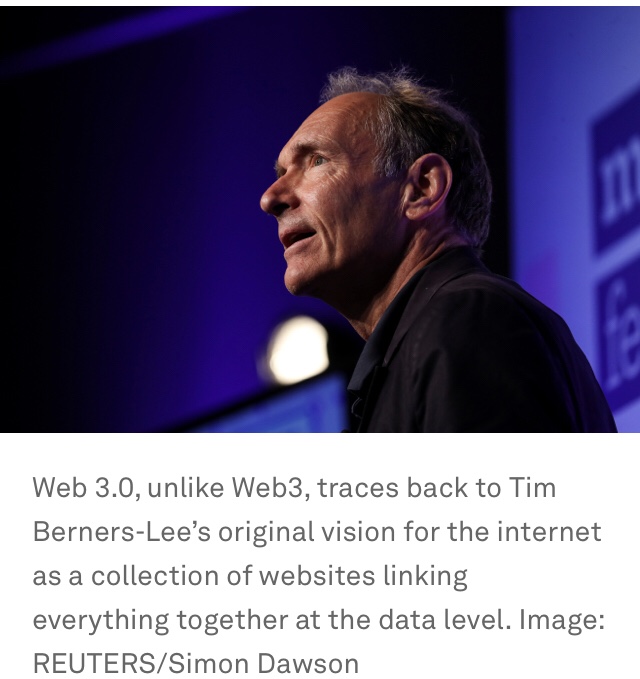
Web 3.0, unlike Web3, traces back to Tim Berners-Lee’s original vision for the internet as a collection of websites linking everything together at the data level. Image: REUTERS/Simon Dawson
These basic “read-only” websites were managed by webmasters who were responsible for updating users and managing the information. In 1992, there were 10 websites. By 1994, after the web entered the public domain, there were 3,000.
When Google arrived in 1996 there were two million. Last year, there were approximately 1.2 billion websites, although it is estimated only 17 per cent are still active.
Web 2.0: The social web
The next major shift for the internet saw it develop from a “read-only web” to where we are currently — a “read-write web.” Websites became more dynamic and interactive. People became mass participants in generating content through hosted services like Wikipedia, Blogger, Flickr and Tumblr.
The idea of “Web 2.0” gained traction after technology publisher Tim O’Reilly popularized the term in 2004.
Later on, social media platforms like Facebook, YouTube, Twitter and Instagram and the growth of mobile apps led to unparalleled connectivity, albeit through distinct platforms. These platforms are known as walled gardens because their parent companies heavily regulate what users are able to do and there is no information exchange between competing services.
Tech companies like Amazon, Google and Apple are deeply embedded into every facet of our lives, from how we store and pay for our content to the personal data we offer (sometimes without our knowledge) to use their wares.
Web3 vs. Web 3.0
This brings us to the next phase of the internet, in which many wish to wrest back control from the entities that have come to hegemonize it.
The terms Web3 and Web 3.0 are often used interchangeably, but they are different concepts.
Web3 is the move towards a decentralized internet built on blockchain. Web 3.0, on the other hand, traces back to Berners-Lee’s original vision for the internet as a collection of websites linking everything together at the data level.
Our current internet can be thought of as a gigantic document depot. Computers are capable of retrieving information for us when we ask them to, but they aren’t capable of understanding the deeper meaning behind our requests.
Information is also siloed into separate servers. Advances in programming, natural language processing, machine learning and artificial intelligence would allow computers to discern and process information in a more “human” way, leading to more efficient and effective content discovery, data sharing and analysis. This is known as the “semantic web” or the “read-write-execute” web.
In Berners-Lee’s Web 3.0 world, information would be stored in databases called Solid Pods, which would be owned by individual users. While this is a more centralized approach than Web3’s use of blockchain, it would allow data to be changed more quickly because it wouldn’t be distributed over multiple places.
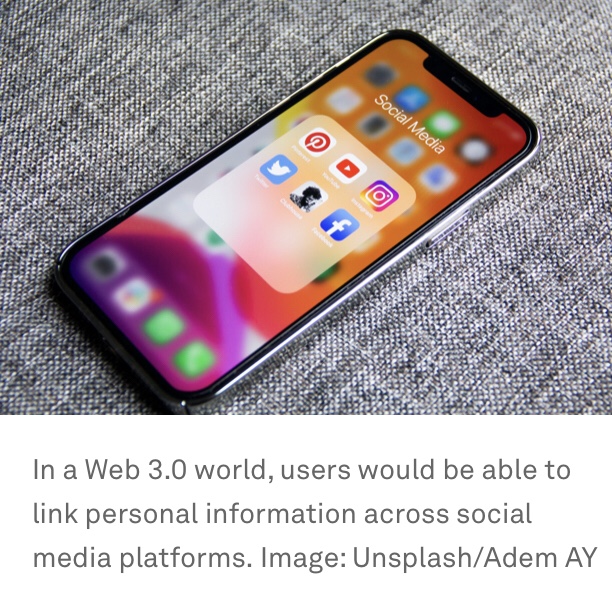
It would allow, for example, a user’s social media profiles to be linked so that updating the personal information on one would automatically update the rest.
The next era of the internet
Web3 and Web 3.0 are often mixed up because the next era of the internet will likely feature elements of both movements — semantic web applications, linked data and a blockchain economy. It’s not hard to see why there is significant investment happening in this space.
Have you read?
- Can the internet really change how the world is run?
- Video: How will the tactile internet change the world?
- Web3: The hype and how it can transform the internet
But we’re just seeing the tip of the iceberg when it comes to the logistical issues and legal implications. Governments need to develop new regulations for everything from digital asset sales taxation to consumer protections to the complex privacy and piracy concerns of linked data.
There are also critics who argue that Web3, in particular, is merely a contradictory rebranding of cryptocurrency that will not democratize the internet. While it’s clear we’ve arrived at the doorstep of a new internet era, it’s really anyone’s guess as to what happens when we walk through that door.
Article link: https://www.weforum.org/agenda/2023/03/what-is-web3-and-how-could-it-change-the-internet?
 healthcarereimagined