healthcarereimagined

Envisioning healthcare for the 21st century

  • About
  • Economics

Researchers Spot Silicon-Level Hardware Trojans in Chips, Release Their Algorithm for All to Try – Hackster.io

Posted by timmreardon on 03/22/2023
Posted in: Uncategorized.

Using thousands of electron microscope images and the original chip layout, 37 of 40 deliberate modifications were spotted.

Researchers at the Ruhr University Bochum and the Max Planck Institute for Security and Privacy (MPI-SP) have come up with an approach to analyzing die photos of real-world microchips to reveal hardware Trojan attacks β€” and are releasing their imagery and algorithm for all to try.

“It’s conceivable that tiny changes might be inserted into the designs in the factories shortly before production that could override the security of the chips,” says Steffen Becker, PhD and co-author of the paper detailing the work, of the problem the team set about to solve. “In extreme cases, such hardware Trojans could allow an attacker to paralyze parts of the telecommunications infrastructure at the push of a button.”

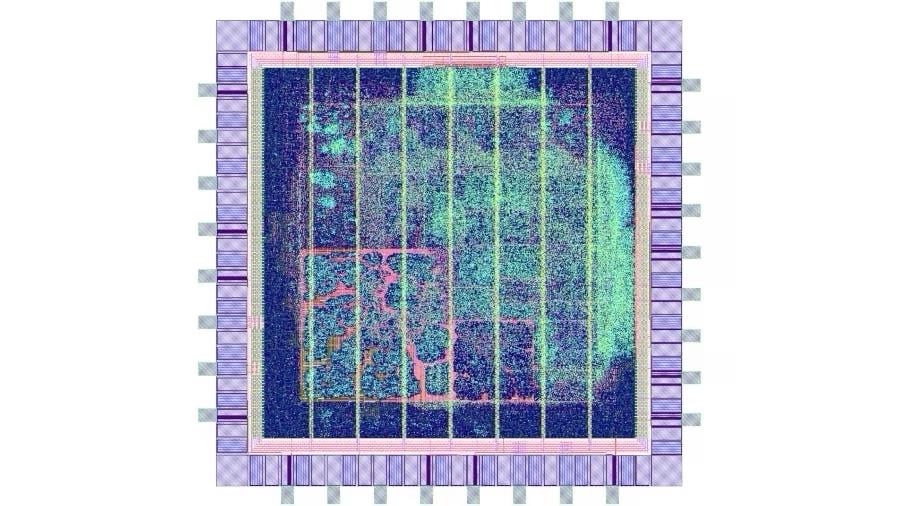
High-resolution die shots and original layout files have proven enough to automatically flag potentially malicious modifications in CMOS chips. (πŸ“·: Puschner et al)

Looking at chips built on 28nm, 40nm, 65nm, and 90nm process nodes, the team set about automating the process of inspecting the finished silicon chips for hardware-level tampering. Using designs created by Thorben Moos, PhD, the researchers figured out a way to test their approach: taking the physical chips Moos had already built and comparing them to original design files with minor modifications, meaning the two are no longer a direct match.

“Comparing the chip images and the construction plans turned out to be quite a challenge, because we first had to precisely superimpose the data,” says first author Endres Puschner. “On the smallest chip, which is 28 nanometers in size, a single speck of dust or a hair can obscure a whole row of standard cells.”

Despite these challenges the analysis algorithm showed promise, detecting 37 of the 40 modifications β€” including all the modifications made to the chips built on process nodes between 40nm and 90nm. The algorithm did, admittedly, throw up 500 false positives β€” but, says Puschner, “with more than 1.5 million standard cells examined, this is a very good rate.”

The team’s approach picked up on modifications (left) compared to the expected design output (right) automatically. (πŸ“·: Puschner et al)

The desire to analyze silicon-level hardware to detect either malicious modifications or counterfeit hardware was also behind recent work by engineer Andrew “bunnie” Huang, who developed a technique for peering inside packaged chips and uncovering the silicon within. Huang’s approach lacks the resolution, however, for cell-level analysis β€” which this research team managed through electron microscopy.

The team’s paper is available under open-access terms on the IACR Cryptology ePrint Archive, while the full imagery and source code behind the paper has been published to GitHub under the permissive MIT license. “We […] hope that other groups will use our data for follow-up studies, Becker says. “Machine learning could probably improve the detection algorithm to such an extent that it would also detect the changes on the smallest chips that we missed.”

Article link: https://www-hackster-io.cdn.ampproject.org/c/s/www.hackster.io/news/researchers-spot-silicon-level-hardware-trojans-in-chips-release-their-algorithm-for-all-to-try-ba00bbd56248.amp

Share this:

  • Share on X (Opens in new window) X
  • Share on Facebook (Opens in new window) Facebook
  • Share on LinkedIn (Opens in new window) LinkedIn
Like Loading...

Related

Posts navigation

← How We’re Bringing the Power of Quantum Computing to Medical Research – Cleveland Clinic
HRSA Announces Organ Procurement and Transplantation Network Modernization Initiative – HRSA →
  • Search site

  • Follow healthcarereimagined on WordPress.com
  • Recent Posts

    • WHAT A QUBIT IS AND WHAT IT IS NOT. 01/25/2026
    • Governance Before Crisis We still have time to get this right. 01/21/2026
    • On the Eve of Davos: We’re Just Arguing About the Wrong Thing 01/18/2026
    • Are AI Companies Actually Ready to Play God? – RAND 01/17/2026
    • ChatGPT Health Is a Terrible Idea 01/09/2026
    • Choose the human path for AI – MIT Sloan 01/09/2026
    • Why AI predictions are so hard – MIT Technology Review 01/07/2026
    • Will AI make us crazy? – Bulletin of the Atomic Scientists 01/04/2026
    • Decisions about AI will last decades. Researchers need better frameworks – Bulletin of the Atomic Scientists 12/29/2025
    • Quantum computing reality check: What business needs to know now – MIT Sloan 12/29/2025
  • Categories

    • Accountable Care Organizations
    • ACOs
    • AHRQ
    • American Board of Internal Medicine
    • Big Data
    • Blue Button
    • Board Certification
    • Cancer Treatment
    • Data Science
    • Digital Services Playbook
    • DoD
    • EHR Interoperability
    • EHR Usability
    • Emergency Medicine
    • FDA
    • FDASIA
    • GAO Reports
    • Genetic Data
    • Genetic Research
    • Genomic Data
    • Global Standards
    • Health Care Costs
    • Health Care Economics
    • Health IT adoption
    • Health Outcomes
    • Healthcare Delivery
    • Healthcare Informatics
    • Healthcare Outcomes
    • Healthcare Security
    • Helathcare Delivery
    • HHS
    • HIPAA
    • ICD-10
    • Innovation
    • Integrated Electronic Health Records
    • IT Acquisition
    • JASONS
    • Lab Report Access
    • Military Health System Reform
    • Mobile Health
    • Mobile Healthcare
    • National Health IT System
    • NSF
    • ONC Reports to Congress
    • Oncology
    • Open Data
    • Patient Centered Medical Home
    • Patient Portals
    • PCMH
    • Precision Medicine
    • Primary Care
    • Public Health
    • Quadruple Aim
    • Quality Measures
    • Rehab Medicine
    • TechFAR Handbook
    • Triple Aim
    • U.S. Air Force Medicine
    • U.S. Army
    • U.S. Army Medicine
    • U.S. Navy Medicine
    • U.S. Surgeon General
    • Uncategorized
    • Value-based Care
    • Veterans Affairs
    • Warrior Transistion Units
    • XPRIZE
  • Archives

    • January 2026 (8)
    • December 2025 (11)
    • November 2025 (9)
    • October 2025 (10)
    • September 2025 (4)
    • August 2025 (7)
    • July 2025 (2)
    • June 2025 (9)
    • May 2025 (4)
    • April 2025 (11)
    • March 2025 (11)
    • February 2025 (10)
    • January 2025 (12)
    • December 2024 (12)
    • November 2024 (7)
    • October 2024 (5)
    • September 2024 (9)
    • August 2024 (10)
    • July 2024 (13)
    • June 2024 (18)
    • May 2024 (10)
    • April 2024 (19)
    • March 2024 (35)
    • February 2024 (23)
    • January 2024 (16)
    • December 2023 (22)
    • November 2023 (38)
    • October 2023 (24)
    • September 2023 (24)
    • August 2023 (34)
    • July 2023 (33)
    • June 2023 (30)
    • May 2023 (35)
    • April 2023 (30)
    • March 2023 (30)
    • February 2023 (15)
    • January 2023 (17)
    • December 2022 (10)
    • November 2022 (7)
    • October 2022 (22)
    • September 2022 (16)
    • August 2022 (33)
    • July 2022 (28)
    • June 2022 (42)
    • May 2022 (53)
    • April 2022 (35)
    • March 2022 (37)
    • February 2022 (21)
    • January 2022 (28)
    • December 2021 (23)
    • November 2021 (12)
    • October 2021 (10)
    • September 2021 (4)
    • August 2021 (4)
    • July 2021 (4)
    • May 2021 (3)
    • April 2021 (1)
    • March 2021 (2)
    • February 2021 (1)
    • January 2021 (4)
    • December 2020 (7)
    • November 2020 (2)
    • October 2020 (4)
    • September 2020 (7)
    • August 2020 (11)
    • July 2020 (3)
    • June 2020 (5)
    • April 2020 (3)
    • March 2020 (1)
    • February 2020 (1)
    • January 2020 (2)
    • December 2019 (2)
    • November 2019 (1)
    • September 2019 (4)
    • August 2019 (3)
    • July 2019 (5)
    • June 2019 (10)
    • May 2019 (8)
    • April 2019 (6)
    • March 2019 (7)
    • February 2019 (17)
    • January 2019 (14)
    • December 2018 (10)
    • November 2018 (20)
    • October 2018 (14)
    • September 2018 (27)
    • August 2018 (19)
    • July 2018 (16)
    • June 2018 (18)
    • May 2018 (28)
    • April 2018 (3)
    • March 2018 (11)
    • February 2018 (5)
    • January 2018 (10)
    • December 2017 (20)
    • November 2017 (30)
    • October 2017 (33)
    • September 2017 (11)
    • August 2017 (13)
    • July 2017 (9)
    • June 2017 (8)
    • May 2017 (9)
    • April 2017 (4)
    • March 2017 (12)
    • December 2016 (3)
    • September 2016 (4)
    • August 2016 (1)
    • July 2016 (7)
    • June 2016 (7)
    • April 2016 (4)
    • March 2016 (7)
    • February 2016 (1)
    • January 2016 (3)
    • November 2015 (3)
    • October 2015 (2)
    • September 2015 (9)
    • August 2015 (6)
    • June 2015 (5)
    • May 2015 (6)
    • April 2015 (3)
    • March 2015 (16)
    • February 2015 (10)
    • January 2015 (16)
    • December 2014 (9)
    • November 2014 (7)
    • October 2014 (21)
    • September 2014 (8)
    • August 2014 (9)
    • July 2014 (7)
    • June 2014 (5)
    • May 2014 (8)
    • April 2014 (19)
    • March 2014 (8)
    • February 2014 (9)
    • January 2014 (31)
    • December 2013 (23)
    • November 2013 (48)
    • October 2013 (25)
  • Tags

    Business Defense Department Department of Veterans Affairs EHealth EHR Electronic health record Food and Drug Administration Health Health informatics Health Information Exchange Health information technology Health system HIE Hospital IBM Mayo Clinic Medicare Medicine Military Health System Patient Patient portal Patient Protection and Affordable Care Act United States United States Department of Defense United States Department of Veterans Affairs
  • Upcoming Events

Blog at WordPress.com.
  • Reblog
  • Subscribe Subscribed
    • healthcarereimagined
    • Join 153 other subscribers
    • Already have a WordPress.com account? Log in now.
    • healthcarereimagined
    • Subscribe Subscribed
    • Sign up
    • Log in
    • Copy shortlink
    • Report this content
    • View post in Reader
    • Manage subscriptions
    • Collapse this bar
 

Loading Comments...
 

    %d