Insights from Three Decades of RAND Research
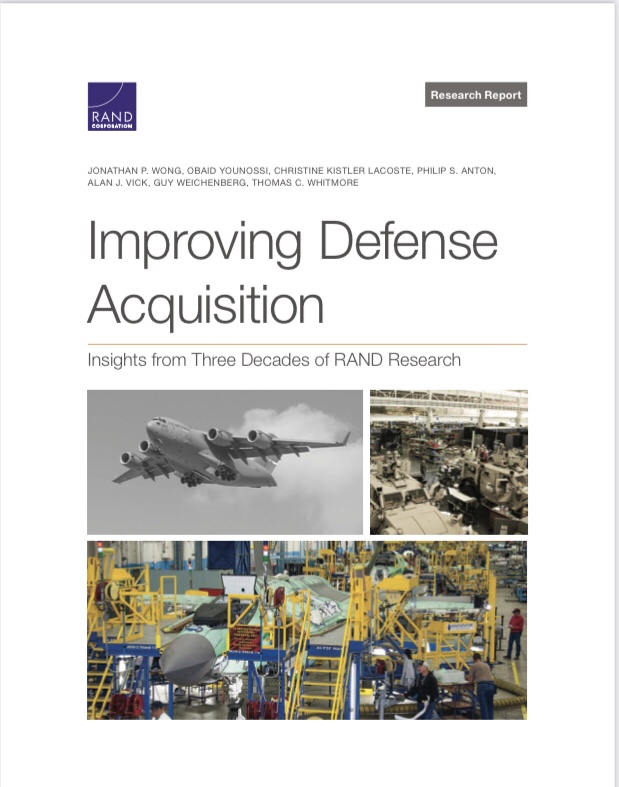
by Jonathan P. Wong, Obaid Younossi, Christine Kistler LaCoste, Philip S. Anton, Alan J. Vick, Guy Weichenberg, Thomas C. Whitmore
- Related Topics:
- Military Acquisition and Procurement,
- Military Budgets and Defense Spending,
- Military Technology,
- United States Department of Defense
- Citation
- Synopsis(print-friendly)
- Embed
- View related products
Download
DOWNLOAD EBOOK FOR FREE
Full Document
PDF file1.3 MB
Technical Details »
Research Summary
PDF file0.1 MB
Technical Details »
Purchase
Research Questions
- What are the overarching trends that affect the DoD acquisition system?
- What challenges does DoD’s acquisition of weapon systems face?
- What insights can RAND research offer on how to confront these challenges?
Improving the U.S. Department of Defense (DoD) acquisition system — the management and development processes by which the department acquires, develops, and sustains weapon systems, automated information systems, and services — has been an issue of sustained interest to policymakers since the beginning of the military establishment. Numerous actions have been initiated and implemented over decades to rein in the increasing life-cycle costs and to ensure a timely delivery of these systems to meet U.S. security needs. In this report, researchers describe overarching trends that affect the defense acquisition system, outline challenges in DoD’s defense acquisition process, and suggest improvements that might help address those challenges. The study is informed by open-source documents and insights from publicly available RAND Corporation research on defense acquisition, especially reports published since 1986, when a similar review of RAND research was published.
Key Findings
Four overarching trends affect the defense acquisition system
- Geopolitical changes have widened the threat landscape; in addition to a resurgent Russia, growing Chinese economic and military power poses new threats to U.S. interests, while Islamic extremism remains a potent force.
- Globalization has altered the economic and technological landscape, creating new opportunities, as well as challenges, for DoD.
- The United States has changing national priorities: Defense issues remain important, but domestic policy issues compel policymakers to prioritize attention and resources.
- Advancing commercial technologies are creating new challenges and opportunities for an acquisition system that was not designed to import and adapt technologies developed outside the traditional defense industrial base.
The trends are linked to the following eight challenges for DoD’s acquisition system
- Responding to evolving missions.
- Leveraging a changing defense industrial base.
- Accommodating interoperability.
- Building in cybersecurity.
- Planning for technology refresh and insertion.
- Rebuilding the acquisition workforce.
- Managing the acquisition cost of systems.
- Aligning incentives, organizations, and processes to acquisition goals.
Recommendations
- To achieve desirable acquisition outcomes, acquisition strategies, organizational roles and responsibilities, and reporting structures must be tailored to the unique characteristics of each program. There is no one-size-fits-all approach that works with every program, and attempts to force programs into a single paradigm lead to problems and inefficiencies.
- It is important to broaden and plan for the defense industrial base. An inclusive industrial base must be better engaged to fully exploit its innovation potential and must be focused on sustaining key parts of the defense industrial base.
- The acquisition workforce must be properly sized, trained, and incentivized to make the smart decisions that flexible acquisition approaches and partnering productively with industry entail.
- DoD needs to continue improving its ability to track and analyze important attributes of the acquisition system. Broadly improving acquisition data collection and analysis would help DoD evaluate the effects of major changes in acquisition policy and better plan for the long term.
Article link: https://www.rand.org/pubs/research_reports/RRA1670-1.html
 healthcarereimagined