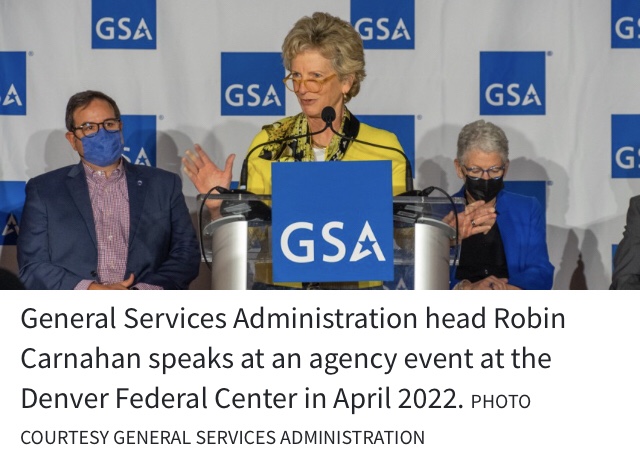
Robin Carnahan, administrator of the General Services Administration, wants to “make the damn websites work.”
That slogan from her Senate confirmation hearing is really shorthand for, “we’ve got to deliver better for our customers when it comes to digital services,” Carnahan said in an interview with FCW.
Carnahan, a veteran of GSA’s digital shop 18F and Georgetown University’s Beeck Center, has been leading GSA for about a year. Earlier in her career, she was the secretary of state in Missouri, where she started to understand that “government services in the 21st century have got to be digital.”
Now, “the exciting thing is we have momentum and money at the same time,” she said. “We want to take advantage of it.”
Since many parts of the online experience with government are the same, like logging into a website, shared services are a tool to implement the White House’s priorities on customer experience, said Carnahan.
The idea that the government should tap into the savings and efficiency of shared services isn’t new, but Carnahan said that the technology has evolved, as has the way that it’s developed.
“We need to be close to our customers. We need to make sure we get feedback from them before we develop programs and implement things to make sure it’s actually serving their needs and in that tight feedback loop where we’re actually improving,” said Carnahan.
Changing the culture will require educating contracting officers and building cross-functional teams with procurement, design and technology employees “holding vendors accountable to get this done,” she said. “This is something that you build into future contracts and that you train folks to know how to both ask for and make sure is being delivered.”
GSA itself is also going to continue to build its platform of shared services products, said Carnahan. The agency is currently working on a shared services roadmap, directed by a 2021 customer experience (CX) executive order and due this month.
A major focus will be USA.gov, the GSA website that is being reimagined as an online “front door” to government services, said Carnahan. That falls in line with a White House initiative to provide government services along the lines of “life experiences” and the executive order on improving CX for users of government services.
Now, “the exciting thing is we have momentum and money at the same time,” she said. “We want to take advantage of it.”
Since many parts of the online experience with government are the same, like logging into a website, shared services are a tool to implement the White House’s priorities on customer experience, said Carnahan.
The idea that the government should tap into the savings and efficiency of shared services isn’t new, but Carnahan said that the technology has evolved, as has the way that it’s developed.
“We need to be close to our customers. We need to make sure we get feedback from them before we develop programs and implement things to make sure it’s actually serving their needs and in that tight feedback loop where we’re actually improving,” said Carnahan.
Changing the culture will require educating contracting officers and building cross-functional teams with procurement, design and technology employees “holding vendors accountable to get this done,” she said. “This is something that you build into future contracts and that you train folks to know how to both ask for and make sure is being delivered.”
GSA itself is also going to continue to build its platform of shared services products, said Carnahan. The agency is currently working on a shared services roadmap, directed by a 2021 customer experience (CX) executive order and due this month.
A major focus will be USA.gov, the GSA website that is being reimagined as an online “front door” to government services, said Carnahan. That falls in line with a White House initiative to provide government services along the lines of “life experiences” and the executive order on improving CX for users of government services.
When the award was first announced in 2021, GSA said that it would initially disburse $27 million and give more funding after benchmarks were reached.
Login.gov currently doesn’t meet the standard for identity proofing, called an “identity assurance level,” set by the National Institute of Standards and Technology, something that previously prevented the IRS in particular from adopting the service. The IRS and GSA are working to add Login.gov as an option after the 2022 filing season, but the head of the IRS has said that Login.gov will need to clear identity assurance level 2 and get to a higher transaction rate.
When asked if she was confident that Login.gov could get to the standards needed by the IRS for the service, Carnahan said that “there are lots of conversations that are continuing with the IRS and throughout the administration about this” as well as how to balance security, privacy and accessibility in identity proofing.
Carnahan also noted that it’s important that Congress “understands the value” of TMF investments like Login.gov, a project where it’ll be “easier to prove value” as more agencies adopt the service.
“We need to have sustained funding in places like the TMF because it’s really the only place in government that has a governmentwide view of what the technology needs are being assessed by technologists,” she said. Current budget cycles mean that agencies can’t move quickly when they identify a digital services need.
The administration is asking for a $300 million appropriation for TMF for fiscal year 2023. Carnahan sees that funding as an investment that will create savings for agencies down the road.
“When people have problems signing in or accessing a website because of some identity problem, what do they do? They call,” Carnahan said, noting the high costs of staffing and operating call centers.
“My view is that better CX saves a lot of money,” she continued. “If you have a good design on a website or you have easy to read instructions, you don’t get calls in the first place .And so investing in good CX is not only good for delivery, it also ultimately is going to save you money because you don’t have to deal with things on the back end.”
Article link: https://fcw.com/digital-government/2022/06/momentum-and-money/367927/
 healthcarereimagined