The UN health agency has for the first time, tagged compulsive video gaming as a mental health condition in its updated classification manual, released on Monday.
“For gaming disorder to be diagnosed, the behavior pattern must be of sufficient severity to result in significant impairment in personal, family, social, educational, occupational or other important areas of functioning and would normally have been evident for at least 12 months,” said the World Health Organization (WHO).
“There are few truer snapshots of a country’s wellbeing than its health statistics,” said WHO. While broad economic indicators such as Gross Domestic Product may skew impressions of individual prosperity, data on disease and death reveal how a population is truly faring.
According to WHO, ICD is the “bedrock for health statistics,” codifying the human condition from birth to death, including all factors that influence health.
These statistics form the basis for healthcare provision everywhere and are at the core of mapping disease trends and epidemics; helping governments decide how money is spent on health services.
Crucially, in a world of 7.4 billion people speaking nearly 7,000 languages, ICD provides a common vocabulary for recording, reporting and monitoring health problems, says WHO.
“Fifty years ago, it would be unlikely that a disease, such as schizophrenia, would be diagnosed similarly in Japan, Kenya and Brazil. Now, however, if a doctor in another country cannot read a person’s medical records, they will know what the ICD code means,” WHO explained.
Without the ICD’s ability to provide standardized, consistent data, each country or region would have its own classifications that would most likely only be relevant locally.
“Standardization is the key that unlocks global health data analysis,” said WHO.
Ready for the 21st century
The eleventh edition of ICD was released on Monday to allow Member States time to plan implementation before it is presented for adoption at the 2019 World Health Assembly.
Noting that it has been updated for the 21st century WHO said: “Over a decade in the making, this version is a vast improvement on ICD-10,” adding that it now reflects critical advances in science and medicine.
Moreover, the guidelines can also be integrated with modern electronic health applications and information systems – making implementation significantly easier, vulnerable to fewer mistakes and allowing more detail to be recorded.
Drug companies enjoy government-sanctioned and -enforced monopolies over the supply of many drugs
As long as pharmaceutical companies have uncontested market power to set prices, those prices will remain a huge problem for Americans
At the core of the nation’s drug pricing problem is one fundamental fact: Drug companies enjoy government-sanctioned and -enforced monopolies over the supply of many drugs.
These monopolies result from patents awarded under federal law for novel molecules. Patents allow manufacturers to prevent competitors from selling the same drug for 20 years from the time the patent is filed. Given that the process of gaining regulatory approval to market their new drug takes time, research suggests new drugs have, on average, 12 to 13 years of market exclusivity.
Once new drugs are approved by the Food and Drug Administration, the monopolies assured by patents enable pharmaceutical companies to charge any price they choose. They generally pick prices that not only cover their development costs, but also generate profits that exceed those of most other industries: for example, the average profit margin for the 25 largest software companies (which are cited as having the same high R&D investment and low production and distribution costs as pharmaceutical companies) was 13.4 percent in 2015, while the average profit margin for the 25 largest drug companies was 20.1 percent in 2015. Drugmakers are also free to raise prices whenever they want at rates they alone determine.
The existence of patents does not totally prevent competition. Often, other companies introduce drugs that are distinct enough to justify their own separate patents and accomplish the same therapeutic goal. This results in competition that lowers drug prices, but often by not enough to make the medications affordable for many patients. In addition, the makers of patented drugs — for example, Mylan’s EpiPen and the weight-loss drug Suprenza — have developed effective mechanisms to extend the lives of their patents beyond 20 years. These approaches include making minor modifications in the formulations or packaging of drugs that have no clinical significance, as well as paying potential generic competitors not to introduce generic drugs.
That said, patents eventually expire, at which point generic drug companies can manufacture the drug and sell it at a much lower price. But even generic drug competition has been weakened recently by generic drug market monopolies, as these manufacturers have bought up their competition. As a result, the prices of old and familiar drugs have risen dramatically. The price of the cardiac drug isuprel has increased more than sixfold between 2013 and 2015, and the price of the antibiotic doxycycline has soared 90-fold over the same period.
As long as drug companies (or a small group) hold monopoly (or oligopoly) power over potent new therapies, there is no free market solution to lowering drug prices. Only a countervailing nonmarket force of equal strength can bring those prices down. Other western industrial countries, recognizing this, authorize their governments to step in and moderate drug prices for the benefit of their citizenry. Some set prices by fiat, while other negotiate with drug companies. In the latter case, the negotiations are sometimes guided by comparative effectiveness analysis that estimates the value of new drugs to patients. Of course, drug companies are free to walk away from such deals, but they generally choose not to, presumably because they still make money from those sales.
Drug companies say their monopoly earnings are necessary to sustain the research and development that produce new drugs. In effect they are saying that they need to be able to charge the very high prices we now see for patented drugs so they can innovate. This raises the questions of how much money society should allocate toward pharmaceutical innovation and who should decide. Setting those questions aside for the moment, we should be very clear about one thing: As long as pharmaceutical companies have uncontested market power to set prices for many patented and generic drugs, those prices will remain a huge problem for Americans and their elected representatives.
When you walk into the Arlington Women’s Center, you see a spacious waiting room with artwork on the wall, maroon chairs, and a friendly receptionist sitting at the front desk.
The obstetrics and gynecology practice serves a high-income suburb of Washington, DC. Framed photographs on the wall advertise the center’s physicians who’ve made lists of the city’s best doctors. It’s a modern, upscale doctor office.
But when it needs to share patient records, it turns to an outdated technology: the fax machine.
“The pages get jammed up so you end up with half-pages that come out at the other end,” says Amanda Rohn, an OB-GYN at Arlington Women’s Center, “or you get blank pages that don’t actually have the information you need.”
“Medical records generally come by fax,” says Amanda Rohn, an OB-GYN at Arlington Women’s Center in Arlington Va. “Sometimes they’re mailed. They almost never come by any other route.”Byrd Pinkerton/Vox
The clinic has digitized its own patient data. But its electronic system can’t connect with other clinics’ records. So when doctors want to retrieve records from another office — an ultrasound for a pregnant patient, for example — they have to turn to the fax.
Most women at the Arlington Women’s Center get their ultrasounds at a radiology office that is in the same building, just a floor below. It also has a digital record. But the two systems don’t connect. So they use a Rube Goldberg-esque analog method for sharing data: Print out pages of one record, fax it, and then scan those pages into the other digital system.
“We have a medical records department who goes through all the incoming faxes, sorts them for which doctor they go to, and then I have a folder where they put my results in,” Rohn says, pointing to a pink file folder on her desk. “If we were all on the same system, I’d be able to see everybody’s results, but since we’re not, there has to be some way they get to me.”
Most industries abandoned the fax machine in the 1990s, and for good reason. Fax machines are terrible at sending data. Busy signals interfere. Printouts are blurry. And sometimes faxes go to the wrong place entirely.
The fax machine at the Arlington Women’s Center is constantly beeping and buzzing with incoming and outgoing patient records.Byrd Pinkerton/Vox
One medical worker recalled a fax fiasco from the 1990s when he practically sent medical records to the moon. “The FBI called about a half-hour later and asked how I got the number,” he said. “I told them that I was faxing Minnesota. They told me I had faxed NASA.”
In the medical sector, the fax is as dominant as ever. It is the cockroach of American medicine: hated by doctors and medical professionals but able to survive — even thrive — in a hostile environment. By one private firm’s estimate, the fax accounts for about 75 percent of all medical communication. It frustrates doctors, nurses, researchers, and entire hospitals, but a solution is evasive.
At Rohn’s obstetrics practice, no one has contacted NASA by mistake, but they’ve had real problems. Lately, doctors have taken to hand-delivering the most important records.
“We used to fax the labor and delivery records, but they didn’t get them or they were misplacing them,” says Hilda Moreno, who manages the office’s medical records. “We kept getting calls like, did you send this? And we’d say we did. So we started printing them out.”
Obama tried to force the health sector to go digital. But he didn’t make the systems talk.
The story of the fax machine’s dominant role in medicine is also the story of a government incentive program that badly misread the economics of American health care.
The Obama administration spent upward of $30 billion encouraging American hospitals and doctor offices to switch from paper to electronic records. The program was a wild success, in one respect. The number of hospitals using electronic records grew from 9 percent in 2008 to 83 percent in 2015, a huge change in less than a decade.
But the program didn’t account for a critical need: sharing. Hospital and doctor offices generally remain unable to transfer electronic information to other hospitals and doctor offices. Billions of dollars later, they are left printing out documents and faxing them. And so the fax machine remains medicine’s dominant method of communication.
Obama officials believed competing health systems would volunteer to share patient data. They now admit that was naive.
“We don’t expect Amazon and Walmart to share background on their customers, but we do expect competing hospital system to do so,” says David Blumenthal, who coordinated health policy for the Obama administration from 2011 to 2013. “Those institutions consider that data proprietary and an important business asset. We should never have expected it to occur naturally, that these organizations would readily adopt information exchange.”
The stimulus package that President Obama signed into law in February 2009 included a 53-page section called the HITECH Act (an acronym for its much clunkier full name: the Health Information Technology for Economic and Clinical Health).
The small part of the massive stimulus bill included more than $30 billion to spend incentivizing doctors to adopt digital records. The law directed a small, little-known government agency — the Office of the National Coordinator for Health Information Technology (ONC) — to develop a program to distribute the money.
“It was quite small and had modest operational responsibilities,” says Blumenthal.
The agency historically subsisted on a meager budget with a few dozen staffers. All of a sudden, it had a multibillion-dollar budget and pressure from the White House to spend that money quickly. The Obama administration hoped this infusion of money would help drag the country out of the 2008 recession.
“The White House looked at these billions of dollars and they saw an opportunity to stimulate the economy,” Blumenthal says. “We did have pressure from the White House to get the money out the door.”
Blumenthal’s team had to move quickly, and decided to focus on getting doctors to adopt electronic records. Once doctors started using electronic records, the thinking at the time went, they would naturally start using more digital forms of communication like secure email.
“Our philosophy was, you’ve got to have the information in bits and bytes before you can start sending those down the internet to someplace else,” Blumenthal says.
Farzad Mostashari, who took over Blumenthal’s position in 2013, recalls the ambitions similarly. “The real goal at the time was, hey, let’s get folks off of paper and onto electronic health records,” he says.
ONC came up with “meaningful use” standards, a checklist of benchmarks that doctor and hospital offices would need to hit in order to receive a small slice of that $30 billion incentive fund. If doctors and hospitals were able to meet these criteria, they’d get bonus payments from the federal government.
All available data suggests that the meaningful use incentives hugely increased the adoption of electronic medical records. A recent paper in the journal Health Affairs compared the adoption of digital records among hospitals (which qualified for these incentive payments) and nursing homes (which didn’t get the bonuses).
It found that the facilities eligible for the bonus payments adopted digital records at a much faster pace than those without much incentive.
“We now have data to suggest the majority of electronic health record adoption was because of the HITECH Act,” says Julia Adler-Milstein, the lead author of that study and an associate professor at the University of California San Francisco School of Medicine. “We would not have seen those double-digit percentage point increases without it.”
If you can now log in to a patient portal at your doctors’ office to schedule a visit, see results of a test, or send a message to your physician, that is likely the result of the HITECH Act.
But if you’ve ever become frustrated trying to get one doctor to talk to another, that is the Obama administration’s legacy too.
“The fax machine is still a major part of medical communication”
Rohn works on that Virginia hospital campus I mentioned earlier. And for years, she’s had a front-row seat to the Obama administration’s struggle to digitize American medicine.
The 36-year-old received an undergraduate degree in engineering and initially planned to pursue a career in programming. “It turned out that I didn’t like spending all my time looking at a computer screen,” she said. “I really wanted to spend my time interacting more directly with people.”
Rohn went back to medical school and in 2013 completed a residency in obstetrics and gynecology at the University of Pennsylvania. She began cold-calling OB-GYN practices that had openings in the DC area, where her husband already had a job.
Office after office told her the same thing: Stop calling us. Just fax us your résumé.
“The fax machine is still a major part of medical communication,” she says. “It’s crazy that I was sending my CV by fax machine in 2013.”
Rohn began sending unsolicited faxes with her résumé to OB-GYN practices, and, amazingly, it worked. One of her faxes went to Arlington Women’s Center, where she works today.
Old paper folders at the Arlington Women’s Center hold records from outside clinics.Byrd Pinkerton/Vox
When Rohn was a resident, she used a lot more paper records. When she saw patients in the hospital after surgery or a delivery, she would handwrite notes in a paper chart.
She started her job just as billions of federal incentive dollars were flowing to get doctors to switch to digital records. Her clinic digitized just before her arrival in 2013. Now, instead of scribbling patient notes in handwriting, she types them into her electronic record.
She can order most lab results through the electronic record, too, after a lengthy effort to connect her office’s digital system with the laboratory they work with most frequently.
“I can see each encounter the patient has had in our clinic, so I can look back and see when my colleague saw this patient last year, read her notes, know what they talk about,” Rohn says.
It’s when she wants to communicate with other offices that things get tricky. The hospital where most of her patients deliver uses Epic, the medical records company with the largest market share in the United States. Rohn’s office uses a smaller company called NextGen.
Each day, Rohn comes into the office to a pink folder on her desk labeled “prenatal labs” that contains a stack of faxes from other offices she needs to enter into the electronic record.
When Rohn’s patients are close to giving birth, at 36 weeks pregnant, she or another doctor hand-delivers their medical records to the labor and delivery department. It’s not a great system.
“Sometimes we can’t find the records because someone has misfiled it or someone never sent it,” Rohn says. “Or they’re not that far along yet in pregnancy if they deliver prematurely.”
Rohn is a highly trained professional. She spent four years at top-ranked medical school and more years after that as a resident learning how to deliver babies, perform surgeries, and help patients through pregnancy.
But because of America’s disconnected medical system, she spends a significant amount of time transcribing medical records and hand-delivering them around her hospital. This is time when she could be using her medical expertise to see more patients or have longer visits. Instead, she’s managing paperwork.
And this wastes her patients’ time too. Sometimes Rohn will have appointments to discuss an abnormal Pap smear but won’t be sent the actual results that show what is abnormal.
“So then I’m seeing someone in consultation for abnormal Pap smear and I don’t know what result was, and we have to decide do we do the test again today when you might not actually need it,” she says.
There are financial incentives to keep using the fax machine
It turns out there are strong economic incentives for doctors to keep patient information to themselves — and even stronger incentives for electronic medical records not to play nicely with each other.
While patients might want one hospital to exchange information with another hospital, those institutions have little incentive to do so. A shared medical record, after all, makes it easier to see a different doctor. A walled garden — where records only get traded within one hospital system — can encourage patients to stick with those providers.
“When you want competing entities to share information, you have to realize that they’re sharing things that could help their competitors,” says Blumenthal.
The program that Blumenthal helped build required hospitals to have the ability to share information, but it didn’t mandate that they do so frequently or make the process especially easy. Most hospitals made a rational business decision and did not invest in technologies that would make it easier for competitors to siphon off patients.
Competitive pressure between the companies that sell electronic record makers themselves only made things worse. The electronic record makers don’t have much incentive to connect well with other records, when they’d rather just convert that hospital on a different electronic platform into one of their own customers.
“If [electronic record vendors] expended all that time and effort to make it so anyone could plug into any other system, it’s reducing the advantage of staying on your particular network,” Mostashari says.
This is especially true for larger electronic medical record companies, which want to sell the advantages of joining a record that is used in lots of doctor offices. “You want to make it easier for people to say, ‘Hey, if you’re on [our electronic record], look how awesome it is! You can talk to any user, anywhere in the country,” he argues.
In short, economics gave hospitals plenty of reasons not to connect their records with other hospitals — to stick with a clunky technology, like fax, that makes it hard to transmit information. And the government didn’t give any incentives to connect — it stopped at digitizing medicine, falling short of the interoperability that patients actually want.
How do you actually kill the fax machine?
Mostashari came away from his time in Washington believing a fix would require more government intervention — namely, outlawing faxing in American medicine. He argues that doctors won’t leave the fax until there is an expiration date, a moment when the government forces them to use secure email instead.
“I think if we want to kill the fax, we need to schedule a funeral,” he says. “I think you need a pull and you also need a push.”
The Trump administration, however, will take a different approach. Donald Rucker now runs the Office of the National Coordinator for Health Information Technology, and did not take kindly to the federal mandate proposal.
“All of the thousands of regulations that have piled on have the net effect of preventing us as individuals from controlling our data, from shopping for care, or having vaguely cost-effective care to shop for,” Rucker said.
He argues that better-designed electronic records will go a long way toward allowing data to transfer more freely. He also cited a new provision in a recent health care law, the 21st Century Cures Act, that requires electronic records to exchange data with other records in a way that requires “no special effort.” What “no special effort” means isn’t yet clear, and will likely be defined in future regulations.
The verdict is still out on whether the Trump administration’s approach can work — or whether, eventually, a more heavy-handed mandate will be needed to actually kill the fax.
But we do know this: As long as the fax sticks around, it is bad for doctors and bad for patients.
What happens in the real world after the government, non-profits, even academic institutions start doing something differently? The Impact looks at policies that work — and policies that need some work — as they make their way out into the real world, with many surprises along the way.
It was just the tip to the data iceberg. Issues around vast data sets, advanced analytics, revenue potential and ownership are all swirling together and reaching critical mass. But let’s take a step back.
Is de-identification a myth?
One of the cornerstones of data monetization is the role of de-identification. The basic premise is that core information is stripped of any reference to the individual. These data are used collectively to establish observations and insights into various trends, from medicine to marketing. That’s a fundamental reality that worked a few years ago. But today’s technology and emerging data sets provide a new and potentially problematic issue: data isn’t really de-identified. In fact, given the right constellation of a just few data points, re-identification can become fairly simple, and even commonplace. We all know about Kevin Bacon and the six degrees of separation. This data connectivity is an extension of this concept where the connections are revealed and subsequent re-identification is established by powerful analytics. So, you have to ask yourself if you trust the “keepers of your data” and if the sacrosanct aspects of privacy are intact.
Is HIPAA adequate for today’s technological age?
The standard by which health care privacy is based—the Health Insurance Portability and Accountability of 1996 (HIPAA)—established the foundation for the protection of personal health information. But a key question remains: is this protection still valid in 2018. Does HIPAA provide adequate protections or is it even capable of providing protections given its current form and the technological world that exists now? And as a basic interpretation of HIPAA, do individuals really have the ability to manage their data beyond a simple “yes” or “no” that offers a middle ground where advantages exist for multiple stakeholders? It seems that there are more questions than answers.
Maybe it’s time to consider data as property.
That’s exactly what Hu-manity.co believes. Launched this week, Hu-manity.co brings together a senior team of healthcare and technology professionals and examines this issue of data and its uses in the context of property ownership. Less an intangible and often ambiguous concept, their perspective is that data is a strategic commodity similar to oil. And just as oil has a single source and ownership, so should data. Their belief is put forth as a fundamental human right and as an extension to the existing thirty human rights declared by the United Nations in 1948 and bestowed at birth.
<span>Simply put, Hu-manity.co has established unique and proprietary technology to establish contracts on blockchains which individuals establish, monitor and modify consent and authorization with corporations for their data. The goal is for those who use this technology will enjoy the property ownership, such as involvement in sale, fair market value negotiations, sharing, security, and protection from theft. Perhaps most importantly, Hu-manity.co takes the complexity out of the process with a simple, yet action-based app that educates and empowers individuals. In healthcare, this can be significant. Beyond moving control back to the individual, the opportunity arises to monetization data, particularly among those with rare and valuable clinical profiles.
We didn’t just invent this construct. It’s a manifestation of human needs in a 21st century, connected world. The implications are transformative to both commerce and mankind.
John Kao MD, MBA—Chief Evangelist, Hu-manity.co
A bold proposition, with broad implications.
While healthcare is a tremendous opportunity, it certainly doesn’t end there. Data defines almost every aspect of our lives. Geolocation, financial, travel, employment, credit, consumption, just to name a few, are potentially the property of the individual. And as property owners, we all have a stake in the power of data. From insights to enhance our lives to the potential to offer personal income, the value of data is being untapped more and more every day. Now, owning your data could advance to a higher order and the consequences for humanity might just be priceless.
On a recent Friday night, I found myself sitting in my office at 7:30 p.m., updating electronic health records (EHRs) 2 1/2 hours after my last patient had left the building. I could have stayed and powered my way through the rest of a long day’s charts. Instead, I got mad and went home.
I’ve been using an EHR for a long time. The one I use now is certified to the latest standards, which means it does everything the government says it should do. Unfortunately, that doesn’t mean it does everything I want it to do.
I’ve been practicing family medicine for more than 35 years in the same small town where I grew up. I spend about seven hours a day seeing patients, and that’s something I love. The issue is that seven hours of patient care requires another seven hours — or more — of administrative work. Half my workday (or night) is spent sitting in front of a screen. At times, I feel like I’ve become an expensive data entry clerk.
No thanks, I’d rather be a family physician.
EHRs may be more legible than our old paper charts, but it’s even harder to find meaningful information in the morass of extraneous information than it was in an old-style, handwritten note.
Now, no one thinks we’re going back to paper charts, but why, after all this time, is using an EHR still this complicated, time-consuming and counterproductive?
The first EHR system was invented in 1972.(1qblb015q58ipcln51ov1m9g-wpengine.netdna-ssl.com) Adoption spread with the proliferation of personal computers in the 1980s and the internet in the 1990s. The potential of the EHR to help us better track disease and outcomes, manage population health, and communicate with other physicians and hospitals has been tantalizing. The reality is that here we still are, cursing our keyboards and hating our EHRs to the point that physicians are experiencing burnout, closing independent practices, retiring early and opting out of traditional practice models.
Reducing administrative burden is one of the Academy’s top priorities, so I want to offer an update on the latest developments on that front.
On Jan. 10, AAFP CEO and EVP Douglas Henley, M.D., and Shawn Martin, senior vice president of advocacy, practice advancement and policy, attended a joint meeting of CMS and the Office of the National Coordinator for Health IT (ONC) regarding administrative burden. Steven Waldren, M.D., director of the AAFP’s Alliance for eHealth Innovation, attended a Feb. 22 followup meeting in which stakeholders were able to provide input and suggest potential solutions.
The Academy also made several recommendations related to prior authorizations, including the idea that all insurers should use a standard form and that prior authorization be eliminated for standard, inexpensive drugs. The Academy also recommended that insurers be required to pay physicians for the time we spend on prior authorizations that exceed a certain number or that are not resolved in a timely fashion.
Our in-person dialogue with ONC and CMS is ongoing. AAFP officers, including me, also have met with representatives from both agencies. And AAFP President Michael Munger, M.D., of Overland Park, Kan., spoke at a CMS roundtable on administrative burden in October.
Our efforts to reduce administrative burden extend beyond the federal agencies. This week, the AAFP Board of Directors will be on Capitol Hill to meet with legislators and congressional staff, and administrative burden will be one of the top items on our agenda. Our message, to both Congress and the federal agencies, is clear: Something must change, and change is long overdue.
We spend a full day taking care of patients. It shouldn’t take another seven to eight hours trying to get paid, meet quality measures and justify our decisions. Physicians and our communities would both benefit greatly if payers and policymakers would allow us to focus on our patients.
May might be the month for flowers but hospitals and other healthcare organizations have hardly slowed down to smell them if EHR implementations and interoperability work are any indication.
Instead, it’s been another busy one, not altogether unlike April before it.
VA inked that pact as Cerner’s work with the Defense Department came under fire from an audit report for being “not operationally suitable,” after which Cerner President Zane Burke responded by suggesting that was fake news possibly.
VA and DoD are two giant EHR customers but they’re not the only ones making the rounds this month.
A new reality also came to light in May: EHR interoperability gets all the attention but lacking information exchange also makes rev cycle work more difficult.
More than 75 percent of respondents to a HIMSS Analytics study, in fact, said the biggest revenue cycle management challenge they face is denied claims and disparate systems are among the reasons why.
Make no mistake, though, disparate EHR systems are also causing issues all their own, notably the fact that the average hospital runs 16 distinct ones as these three charts demonstrate.
So it’s no surprise that KLAS Research found the EHR market in flux within its latest marketshare report, and pointed specifically to smaller hospitals seeking new technologies hosted in the cloud.
Holzer Medical Center in Jackson, Ohio, for instance, revealed plans to switch from Allscripts to athenahealth in late May or early June for EMR and other cloud-based services.
Allscripts, for its part, announced that is acquiring HealthGrid at a cost of $60 million plus another $50 million in potential earn-out payments for its mobile patient engagement platform. And athenahealth’s ongoing takeover bid from activist investor Elliott Management saw its plot thicken as Janus Henderson Group, which owns 11.9 percent of the EHR maker’s stock, publicly encouraged athena’s board to consider a sale.
Indeed, all signs of a market in flux. On the higher-end, Kalorama determined that Cerner has more than double the marketshare of rival Epic.
Back on the interoperability and patient safety fronts, HIMSS posted a new free tool called the Environmental Scan of Interoperability Initiatives that hospitals (or anyone for that matter) can use to better understand connectivity options provided Epic’s Care Everywhere, Carequality, CommonWell, the Sequoia Project and others. ONC, meanwhile, kicked off its Easy EHR Issue Reporting challenge to inspire developers to create a way for clinicians to, well, report safety issues right in the EHR workflow.
Looking ahead to the future, Allscripts, Epic and others gave us a glimpse of what their next-gen EHRs will look like so here’s a hint: automation analytics, telemedicine, genomics and more.
After a five-year fight, the Virginia legislature voted this week to expand the Medicaid program to an estimated 400,000 low-income residents who are not currently eligible for health coverage. And New Jersey became the second state to impose a state-level “individual mandate” requiring most residents to have health insurance or pay a fine, following last year’s repeal of the federal penalty.
Meanwhile, Congress has quietly passed a major bipartisan bill to overhaul and streamline health programs provided to the nation’s veterans. The bill includes an expansion of veterans’ ability to get private care paid for outside the Department of Veterans Affairs system, in certain cases.
Also this week, an interview with Dr. Arthur Kellerman, dean of the Uniformed Services University of the Health Sciences, the military’s medical school in Bethesda, Md.
This week’s panelists for KHN’s “What the Health?” are Julie Rovner of Kaiser Health News, Joanne Kenen of Politico, Paige Winfield Cunningham of The Washington Post and Rebecca Adams of CQ Roll Call.
Among the takeaways from this week’s podcast:
Two key factors helped push Medicaid expansion through the Virginia General Assembly. One was the Trump administration’s endorsement of work requirements for nondisabled adults and the other was the blue wave that shook the state last November when the House of Delegates nearly turned from a safe Republican majority to Democratic control.
New Jersey’s passage of a mandate that state residents get coverage or face a penalty was surprising because that provision was one of the most disliked parts of the federal Affordable Care Act.
Even as Congress sent the president the bill expanding VA programs, there is a widening debate in Washington about whether the system should be privatized. That debate has helped both create the vacancy at the top of the Department of Veterans Affairs and complicated efforts to fill it.
Plus, for “extra credit,” the panelists recommend their favorite health stories of the week they think you should read, too.
Julie Rovner: Bloomberg News’ “Is There a Doctor Aboard? Airlines Often Hope Not,” by Ivan Levingston
Joanne Kenen: The Atlantic’s “Ambien Doesn’t Cause Racism,” by Olga Khazan
Rebecca Adams: ProPublica’s “Why Your Health Insurer Doesn’t Care About Your Big Bills,” by Marshall Allen
Paige Winfield Cunningham: The New York Times’ “Origins of an Epidemic: Purdue Pharma Knew Its Opioids Were Widely Abused,” by Barry Meier
Also: The New Yorker’s “The Family That Built an Empire of Pain,” by Patrick Radden Keefe
 UN News/Elizabeth Scaffidi – A young woman plays a video game on her phone.

 “Medical records generally come by fax,” says Amanda Rohn, an OB-GYN at Arlington Women’s Center in Arlington Va. “Sometimes they’re mailed. They almost never come by any other route.”
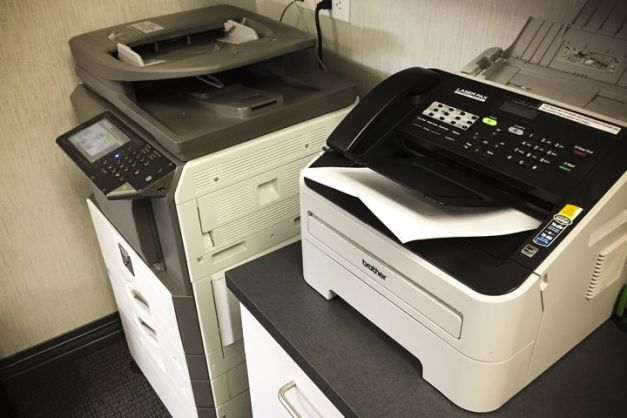 The fax machine at the Arlington Women’s Center is constantly beeping and buzzing with incoming and outgoing patient records.
 Old paper folders at the Arlington Women’s Center hold records from outside clinics.
 Hu-manity.c


 healthcarereimagined